The quick answer
Replacing a working incandescent or halogen bulb can make sense when the fixture runs many hours and the LED price is reasonable; in high-use sockets, the savings can repay the bulb in months. It usually makes less sense to replace a working LED or a bulb in a rarely used fixture, where annual savings are small. Compare light output in lumens, confirm dimmer and enclosed-fixture compatibility, and calculate payback with your own hours and electricity rate.
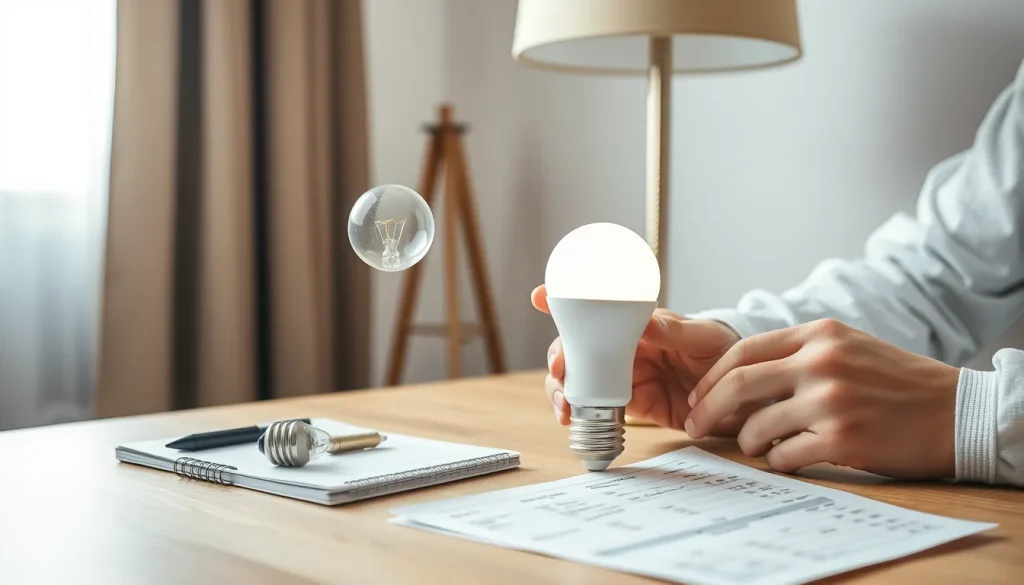
Replacing a bulb that still works can feel wasteful. In energy terms, the better question is not whether the old bulb still lights, but whether it uses enough electricity in a high-use socket to justify the new bulb’s purchase price. The answer is often yes for an incandescent or halogen bulb in a kitchen, living room, or porch light that runs for hours each day. It is often no for a bulb in a closet, a working LED, or a fixture where compatibility is uncertain.
A simple decision rule
Use three tests before buying a replacement for a working bulb: the fixture runs many hours, the existing bulb is an older low-efficiency type, and a compatible LED is available at a sensible price. When all three are true, calculate the savings. When the bulb is rarely used or is already an LED, waiting until it fails is usually the practical choice. A working CFL sits in the middle: it is more efficient than an incandescent, so the savings from switching to LED are smaller and deserve a separate calculation.
The NRDC notes that incandescent bulbs can waste up to 90 percent of the energy they use as heat, and that halogen versions used about 25 to 30 percent less power than standard incandescent bulbs. That inefficiency is what creates the savings opportunity, but the size of the opportunity still depends on hours of use and your electricity rate.
Calculate annual savings and payback
Start with the bulb you would remove. Find its wattage. Then choose an LED that produces similar light and note its wattage and price. Use the bulb’s actual or estimated daily hours, not the fixture’s maximum. For a simple estimate, use 365 days.
Annual energy in kWh = (watts ÷ 1000) × hours per day × 365. Annual cost = annual energy × electricity rate. Annual savings = old annual cost minus new annual cost. Simple payback = LED purchase price ÷ annual savings.
Example: a 60-watt incandescent runs 3 hours per day. A 9-watt LED produces comparable light in this illustration and costs $3. At 18.6 cents per kWh, the rate used on a Hollis, New Hampshire municipal energy page, the old bulb uses 65.7 kWh per year and costs $12.22. The LED uses 9.9 kWh per year and costs $1.83. The modeled savings are $10.39 per year, so the simple payback is $3 ÷ $10.39 = 0.29 years, or about 3.5 months. The Hollis page uses similar local-rate arithmetic to estimate a three-month payback for replacing a working incandescent with an LED. Treat that as a local illustration, not a promise for every home.
| Scenario | Use | Electricity rate | LED price | Annual savings | Simple payback |
|---|---|---|---|---|---|
| 60 W incandescent to 9 W LED | 3 hours per day | 18.6 cents per kWh | $3 | $10.39 | About 3.5 months |
| 60 W incandescent to 9 W LED | 0.5 hours per day | 18.6 cents per kWh | $3 | $1.73 | About 1.7 years |
| 60 W incandescent to 9 W LED | 3 hours per day | 12 cents per kWh, hypothetical | $3 | $6.70 | About 5.4 months |
| 13 W CFL to 9 W LED | 3 hours per day | 18.6 cents per kWh | $3 | $0.81 | About 3.7 years |
The table shows why a blanket answer does not work. The same bulb swap can pay back in months in a frequently used socket or take years in a low-use socket or when replacing an already efficient CFL. Use your own rate, bulb price, and hours to replace these illustrative inputs.
Compare light output, not just watts
A 60-watt incandescent is not a brightness standard. Brightness is measured in lumens, while watts measure power. Choose an LED by the lumens on the package and by the intended room, then check that the bulb fits the fixture.
Also check base type, dimmability, enclosed-fixture rating, and compatibility with any existing dimmer. A bulb labeled not for enclosed fixtures may overheat in a ceiling can. A non-dimmable LED may flicker on a dimmer. Color temperature matters too, because a very cool LED in a living room may feel wrong even if it saves energy. Australia’s government energy site reports that LEDs use about 75 percent less energy than halogen bulbs and last 5 to 10 times longer; exact performance varies by product, but the comparison principle is useful when selecting a like-for-like replacement.
When replacing a working bulb makes sense
- High-use incandescent or halogen fixtures: A kitchen ceiling, living room lamp, home office light, or porch light that runs for several hours a day offers the clearest savings.
- Higher electricity rates: A higher price per kWh shortens payback, but use the rate that applies when the bulb runs. With time-of-use pricing, that may differ from the bill’s average rate.
- Hard-to-reach fixtures: Longer LED life can reduce replacement effort in high ceilings or awkward locations, provided the LED is compatible with the fixture.
- High-use CFLs near the end of their life: The energy savings from CFL to LED are smaller, but replacing a failing or flickering CFL with a suitable LED can still be reasonable. CFLs contain a small amount of mercury, so dispose of them according to local rules.
When to wait
- Working LEDs: Replacing one working LED with another usually saves little or no energy. Replace it mainly for failure, flicker, poor color, or a feature you need.
- Rarely used fixtures: A closet, spare bedroom, or utility light that runs a few minutes a day produces small annual savings. The payback can stretch for years.
- Uncertain compatibility: Dimmers, enclosed fixtures, low-voltage systems, and nonstandard bases need checks before purchase. A cheap bulb that flickers or fails early is not a saving.
- Renters facing fixture changes: A simple bulb swap is usually renter-friendly, but hardwired or nonstandard fixtures may need landlord approval.
Renter-friendly and installation checks
- Pick one high-use fixture and write down the old bulb’s wattage and estimated daily hours.
- Read the fixture label for maximum wattage and any enclosed-fixture rating.
- Match the base type and confirm whether the LED must be dimmable.
- Compare lumens, color temperature, and price before buying.
- Turn off the fixture before changing the bulb. If the socket, wiring, or fixture is damaged, stop and use a qualified professional.
Renters can often replace standard screw-base bulbs and keep the originals for move-out. Avoid modifying wiring or removing a fixture without permission. For homeowners, a bulb swap is a simple maintenance task; fixture replacement or dimmer changes may require an electrician.
Common mistakes and limitations
Do not compare wattage alone. A lower-wattage LED may be brighter or dimmer than the old bulb, so lumens matter. Do not assume the whole electricity bill will fall by the modeled amount: fixed fees, taxes, and other charges remain, and lighting is only one part of household use. Use the marginal or time-of-use rate for the hours the bulb runs when possible. The simple payback here excludes rebates, taxes, installation labor, and any small heating or cooling interaction. In a cold climate, waste heat from an incandescent can contribute a little warmth in winter; in an air-conditioned home, that heat can add cooling load. These effects are usually secondary to the lighting savings but are part of a complete estimate.
A practical next step
Choose one high-use fixture and gather four numbers: old wattage, estimated hours per day, replacement LED wattage, and LED price. Add your electricity rate and run the formula. If the simple payback is short, the fixture is compatible, and the light quality suits the room, replacing the working bulb is a sensible upgrade. If payback is several years or the fixture is rarely used, wait until the bulb fails and revisit the choice then.
FAQ
Is it worth replacing a working incandescent bulb with an LED?
Often yes in a high-use socket. Use the formula with your own hours, electricity rate, and LED price. If the bulb runs less than about an hour a day, annual savings may be small and payback can stretch beyond a year.
What if I already have working CFLs?
CFLs are more efficient than incandescent bulbs, so the savings from switching to LED are smaller. Calculate the difference between the CFL wattage and LED wattage; replace a working CFL mainly when use is high, the LED is compatible, or the CFL is near failure. Handle and dispose of CFLs according to local mercury rules.
Do LEDs work in enclosed fixtures and on dimmers?
Only when the product is labeled for the application. Check for dimmable LEDs and a compatible dimmer, and use an LED rated for enclosed fixtures. Otherwise, overheating, flicker, or short life can occur.
Should I replace working LEDs to save energy?
Usually no. A working LED to another LED saves little or no energy unless the old LED is unusually inefficient. Replace working LEDs mainly for failure, flicker, poor color, or a feature you need.
Follow the evidence
Sources & references
- Natural Resources Defense Council (NRDC). How to Shop for Energy-Efficient Light Bulbs. April 29, 2022. https://www.nrdc.org/stories/how-shop-energy-efficient-light-bulbs
- Empire LEDs. LED Lighting Energy Savings Calculator: How to Estimate the Real Payback. June 15, 2026. https://empireleds.com/blog/led-lighting-energy-savings-calculator-real-payback
- Town of Hollis, New Hampshire. The HEC's Lowdown on LED's. No date shown. https://www.hollisnh.gov/1692/The-HECs-Lowdown-on-LEDs
- Australian Government, energy.gov.au. Lighting. No date shown. https://www.energy.gov.au/households/lighting
Useful terms in this guide
- Lumen
- A measure of visible light output; the basis for comparing brightness between bulb types.
- Kilowatt-hour (kWh)
- Energy equal to 1,000 watts used for one hour.
- Simple payback
- Purchase cost divided by annual savings; it ignores financing and some secondary effects.
- Color temperature
- A Kelvin rating describing whether light looks warm or cool; it is not a measure of energy use.
Have a question about these numbers?
Tell us what needs a closer look.