The quick answer
Home battery storage lets a household shift electricity from when it is generated or cheap to when it is needed, but the useful value depends on usable capacity, power output, controls, tariff, and whether backup is designed in. Capacity tells you how much energy the battery holds; power tells you how fast it can deliver it, and a battery does not provide power during an outage unless the system includes backup capability.
Home battery storage is easy to describe and harder to value. A battery stores electricity so you can use it later, but the useful question is not only how many kilowatt-hours it has. It is how much of your electricity use the system can shift, at what cost, and with what backup capability. This guide explains capacity, power, backup, and value for a U.S. household. It separates the physical limits of the equipment from the parts you can control, such as tariff choice, load timing, solar self-consumption, and backup circuits. It also shows a worked example with clearly labeled assumptions. It does not quote current product prices, incentives, or rankings; those require local, dated sources.
The practical question: what can a home battery actually do?
At its core, a home battery is a time-shifting device. It charges when electricity is available or cheap and discharges when you want to use it. Energy Advice England describes a home battery as an energy storage device that can charge and discharge electricity and shift electricity from one time to another. It can store solar electricity for evening use, and it can also charge from the grid (Energy Advice England).
That description covers three common goals. The first is to use more solar electricity on site instead of exporting it. CHOICE describes the basic promise of solar plus battery storage as storing free surplus electricity for use later at night or on low-sunlight days, which can mean less grid power, lower bills, and a lower carbon footprint (CHOICE). The second is to shift grid purchases under a time-of-use or demand tariff. The third is resilience: keeping some or all of a home powered during an outage. Wirecutter notes that interest in solar plus battery backup has grown as severe weather knocks out grids, and that fossil-fuel generators can be vulnerable to fuel shortages after a disaster (Wirecutter).
These goals overlap, but they are not the same purchase. A battery sized to soak up a modest solar surplus may be too small for whole-home backup. A battery sized for backup may sit mostly idle in normal operation if the household has a flat rate and little solar surplus. Before comparing products, write down the job you want the battery to do and how you will judge success. Good success metrics include lower annual import under a stated tariff, a measured increase in solar self-consumption, or a tested backup runtime for a named list of circuits. A vague goal such as energy independence is hard to quote or verify.
It also helps to separate what you can measure and control from what you cannot. You can control appliance timing, thermostat settings, which circuits are backed up, whether you enroll in a time-of-use plan, and how the battery controls are configured. You cannot control weather, outage timing, future utility rates, or the rules your utility applies to export credits and interconnection. A realistic plan treats the first group as design choices and the second as sensitivity cases.
Capacity, power, and the units that matter
Two specifications do most of the work in a battery quote: energy capacity and power output. Energy capacity is measured in kilowatt-hours (kWh). Power is measured in kilowatts (kW). A battery with 10 kWh of capacity and 5 kW of power can hold up to about 10 kWh of energy and discharge it at a rate of up to 5 kW. If it were full and losses were ignored, 5 kW for two hours would use 10 kWh, while 1 kW for ten hours would also use 10 kWh. Real systems deliver less because of efficiency losses, reserve settings, and degradation.
Energy Advice England makes the same distinction: a battery stores electricity measured in kWh and can supply power to the home measured in kW (Energy Advice England). That difference matters when you shop. A large kWh number does not tell you whether the battery can start a well pump, run an air conditioner, or carry several large loads at once. A high kW number does not tell you how long the battery will last. E.ON Next advises buyers to look closely at how much energy a battery can store, how fast it can deliver power, overall longevity, and how well it handles real-world home energy demands (E.ON Next).
Usable capacity is not nameplate capacity
Battery ads and quotes often lead with a nameplate capacity. The number you can plan around is usable capacity: the portion of that energy the system allows you to draw in normal operation. Manufacturers may hold back a reserve to protect the battery, and the controls may keep a separate backup reserve. E.ON Next lists usable capacity and power output among the first things to compare (E.ON Next). If a battery is advertised as 10 kWh but the system allows 90% depth of discharge, the starting point for planning is 9 kWh, before efficiency losses. If a backup reserve is set to 20%, even less may be available for routine bill savings.
For a simple energy estimate, use the relationship energy equals power times time. A 2 kW load running for 3 hours uses 6 kWh. A 10 kWh battery with 9 kWh usable capacity could, in theory, run that load for about 4.5 hours if the load were steady and losses were zero. That is an arithmetic starting point, not a runtime promise. Loads cycle, surge, and change over the course of an outage.
Round-trip efficiency and losses
Round-trip efficiency is the share of electricity put into the battery that comes back out. If a system has 90% round-trip efficiency, 10 kWh going in might deliver about 9 kWh later. The rest is lost mainly as heat during charging and discharging. Efficiency varies by product, power level, temperature, and operating mode, so use the manufacturer’s documented value for the specific equipment and ask whether it includes standby consumption. E.ON Next flags efficiency during charge and discharge as a buying consideration because energy lost as heat is energy you paid for but cannot use (E.ON Next).
Efficiency affects both bill savings and backup runtime. A battery that looks large on paper may deliver noticeably less useful energy at the point of use. For rough planning, multiply usable kWh by an efficiency factor before comparing it with a load. Keep the factor visible in any calculation so you can test a lower value later.
Continuous power, peak power, and surge loads
Power ratings come in more than one form. Continuous power is the rate the battery and inverter can supply for a sustained period. Peak or surge power is a higher rating for a short duration, often intended to help with motor starts. The definitions and durations are product-specific, so read the datasheet rather than assuming a peak rating can be sustained. A battery with enough kWh for an overnight outage can still fail to run a home if its kW rating cannot handle the simultaneous loads. Large appliances such as electric ovens, heat pumps, air conditioners, and well pumps can draw much more at startup than while running. A backup design may use load management, soft starts, or a critical-load panel to keep demand within the inverter’s capability.
Lifespan, warranty, and degradation
A battery’s useful capacity declines over time and with use. The warranty should state the warranty period, the minimum capacity retention, any cycle or throughput limit, and what is covered for labor and replacement. E.ON Next advises buyers to examine expected lifespan, warranty terms, and degradation cover (E.ON Next). A long warranty that guarantees only a modest fraction of original capacity may not support the bill savings in a sales projection. Ask for the warranty document, not just the headline years, and check whether backup equipment and monitoring are covered.
How a home battery fits into a household energy system
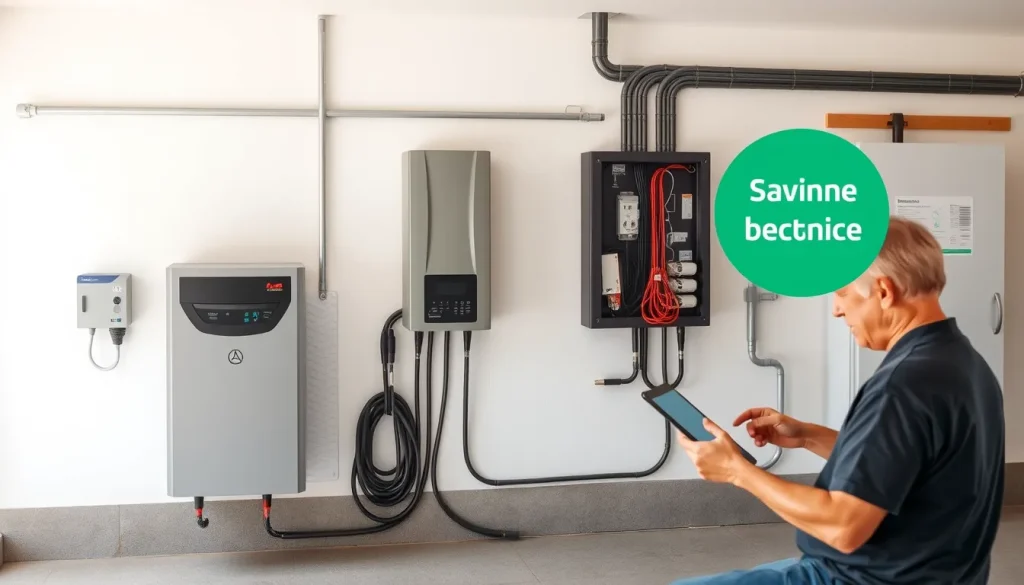
A battery is one part of a system that includes solar panels if present, one or more inverters, a main electrical panel, controls, monitoring, and sometimes a backup subpanel. The architecture determines what the battery can do and what can be added later. The two broad arrangements are direct-current coupling and alternating-current coupling. In a direct-current-coupled or hybrid system, the battery and solar array share an inverter. In an alternating-current-coupled system, the battery has its own inverter and can be added to an existing solar system. Each has trade-offs in efficiency, retrofit flexibility, backup capability, and equipment compatibility. The right choice depends on the existing equipment and the backup goal, not on a slogan.
Solar-coupled systems and self-consumption
With solar, the battery’s main job is usually to raise self-consumption: the share of solar generation used on site instead of exported. Without a battery, surplus solar may be exported to the grid for a credit, depending on the utility’s rules. With a battery, some of that surplus can be stored and used later. The bill value is not the full value of the solar generation. It is the value of the energy shifted, minus the cost of charging, minus losses, and minus any export credit you gave up. CHOICE’s guide describes the appeal of storing surplus solar for later use, but the financial result still depends on the export rules and the household’s evening load (CHOICE).
Self-consumption is easiest to estimate when you have interval data for solar production and home use. If your solar system regularly exports 8 kWh on sunny afternoons and your evening load is 4 kWh, a battery larger than the shiftable surplus may not add much bill value on those days. Seasonality matters too. A system that cycles fully in spring and autumn may be idle or partly charged in winter. Annual generation alone does not tell you how much surplus is available when the battery can actually charge.
Grid-charged systems and time-of-use tariffs
A battery can also charge from the grid when the controls and tariff allow it. Energy Advice England notes that batteries are often used to store solar electricity for evening use but can also charge from the grid (Energy Advice England). This is the basis of time-of-use arbitrage: charge when the price is low, discharge when the price is high. It can also help with demand charges if the controls can predict and shave a short peak. The value depends on the price spread, the number of effective cycles, the round-trip efficiency, and whether the battery has enough power to reduce the billed demand interval. A narrow spread may not cover the losses and equipment cost. A flat rate offers little arbitrage value, although backup or resilience may still justify a battery for some households.
Controls, operating modes, and monitoring
The same battery can behave very differently under different control settings. Common modes prioritize solar self-consumption, reserve capacity for backup, time-of-use charging, or peak shaving. Some systems let the homeowner set a backup reserve, and some let the utility or aggregator manage the battery in exchange for a payment or bill credit. Performance depends on system design, the household’s electricity use, and how the battery is controlled, as Energy Advice England notes (Energy Advice England). Ask how the controls decide when to charge and discharge, whether the settings can be changed, what happens during an outage, and what data the monitoring app records. A battery without useful monitoring is hard to evaluate after installation.
What a home battery is not
A home battery is not a generator. It does not create energy; it stores and releases it. It is not automatically a backup system. Energy Advice England states plainly that a battery does not automatically provide backup power during a power cut (Energy Advice England). It is not a guarantee of lower bills, because bill value depends on tariffs, export rules, cycling, and controls. It is not automatically a carbon reduction, because charging from a carbon-intensive grid at the wrong time can offset some of the benefit of shifting solar. And it is not a simple investment with a fixed return. Treat any payback figure as a scenario built on assumptions, not as a promise.
Backup power: what changes when the grid goes down
Backup is the feature most likely to be misunderstood. A grid-tied solar and battery system normally synchronizes with the utility. During an outage, it must disconnect from the grid to avoid energizing lines while workers repair them. That means a battery can be full and still not deliver power to the house unless the system is designed for backup operation. The design usually includes a backup-capable inverter or gateway, a transfer means, a backup loads panel, and controls that can form an isolated electrical island. The exact equipment varies, but the principle is consistent: backup is a system design, not a checkbox on the battery.
Wirecutter’s reporting on solar and battery backup is a useful reminder of why households ask for this capability: increasingly intense weather can knock out the grid, and fuel-based backup can face shortages after a disaster (Wirecutter). That resilience value is real, but it is not the same as annual bill savings. A backup system can be worth buying for reasons that a simple payback calculation will not capture. The mistake is to buy a battery for backup without confirming that the quoted equipment and wiring actually provide it.
Whole-home backup versus critical-load backup
Whole-home backup aims to keep the entire electrical panel powered. It requires enough continuous and surge power for all the loads that might run at once, and enough usable energy to ride through the outage. That can mean a large inverter, a large battery, or both, plus controls that manage heavy loads. Critical-load backup powers a selected set of circuits, often through a subpanel. The list might include a refrigerator, freezer, lights, internet router, medical equipment, and a heating or cooling circuit. Critical-load backup usually costs less and is easier to fit within a modest battery’s power rating, but it means some circuits go dark during an outage. The right choice depends on which loads matter, for how long, and whether the household can manage loads manually.
Runtime is a load problem, not just a battery-size problem
Backup runtime depends on the average load, not only on the battery’s kWh. A simple planning formula is:
Backup runtime in hours = usable backup energy in kWh × backup-path efficiency ÷ average backup load in kW.
For an illustrative example, assume 9 kWh of usable energy is reserved for backup, the backup path is 90% efficient, and the average backed-up load is 0.5 kW. The delivered energy is 9 × 0.90 = 8.1 kWh. Runtime is 8.1 ÷ 0.5 = 16.2 hours. If the average load rises to 2 kW, runtime falls to 8.1 ÷ 2 = 4.05 hours. These are arithmetic examples, not product claims. Real loads cycle, and a heating system or refrigerator may draw high power intermittently. A backup load schedule with running and starting watts is more useful than a single whole-home kW guess.
Solar can recharge a battery during a long outage only if the system is designed to operate off-grid and the sun is available. Do not assume that a solar array will keep a battery full during an outage. The inverter must be capable of forming a grid while isolated, and the controls must prioritize the backup loads. Ask the installer to explain exactly what happens on a sunny day during an outage, and what happens on a cloudy day.
Value: where battery savings come from
Battery value is easiest to understand as a comparison between two otherwise identical cases: one with the battery and one without. The difference in the bill is the bill savings. The difference in resilience is a separate benefit. The difference in carbon emissions depends on when the battery charges and what generation it displaces. Sales projections sometimes blur these categories. Keep them separate. A battery can reduce imports and still have a long payback. It can improve backup resilience and have no routine bill savings at all. It can lower carbon in one tariff and raise it in another if charging shifts to dirtier hours.
Self-consumption value
For a solar household, the value of one kWh cycled through the battery can be approximated as the avoided import price minus the cost of charging minus losses. If the battery charges from surplus solar that would otherwise be exported, the charging cost is the export credit foregone. If the surplus would otherwise be curtailed or not generated, the foregone credit may be zero. If the battery charges from the grid, the charging cost is the off-peak price plus any fees or taxes that apply. Round-trip efficiency reduces the delivered kWh. A simple expression is:
Net value per charge ≈ delivered kWh × avoided import price − charged kWh × charging cost.
This expression is a bill-value estimate, not a full financial return. It ignores demand charges, standby losses, degradation, financing, and fixed costs. It also assumes the battery has somewhere to discharge the energy. A household with a small evening load may not use a full charge before the next solar day, especially in summer.
Time-of-use and demand-charge value
Under a time-of-use tariff, the battery’s value depends on the price difference between charging and discharging periods, the number of days it can profitably cycle, and the efficiency loss. A wide spread with a long on-peak window can support more value than a narrow spread with a short window. Demand charges are different: they are based on a customer’s highest demand during a billing period, often measured over a short interval. A battery can shave that peak only if the controls can predict it and discharge at the right time. The savings may be concentrated in a few intervals per month, so the control algorithm and the utility’s measurement rules matter as much as the battery’s kWh.
Export credits and net metering
Export rules can change the self-consumption case dramatically. If a utility pays a credit close to the retail import rate for exported solar, storing the solar for later may save little on the bill because the export credit was already valuable. If the export credit is low or zero, using the solar on site may be worth more. If export compensation is time-varying, the battery may be able to export at a high-value period instead of charging for later use. These rules are local and can change. Do not assume that a battery always increases the value of solar; compare the battery case with the no-battery case under your actual export tariff.
Backup and resilience value
Backup value is real but hard to put in a bill. It can include avoiding spoiled food, protecting medical equipment, keeping communications and work equipment running, or avoiding the cost and fuel logistics of a generator. Wirecutter notes that fuel-based backup can be vulnerable to fuel shortages after a disaster, which is part of the resilience case for solar plus battery (Wirecutter). If backup is a primary goal, evaluate it with a load list and a runtime target. Do not add an invented monthly dollar value for resilience to make a payback look better. State it as a separate benefit and decide whether it is worth the cost to you.
What does not count as battery savings
Several common claims overstate battery value. Total solar generation is not battery savings; only the energy shifted by the battery can count. A tax incentive or rebate is not annual bill savings; it reduces the installed cost. A backup feature is not a cash flow unless you can document a specific avoided cost. A battery is not full every day, and it does not necessarily cycle 365 times a year. Rated power is not average load. And a simple payback that ignores degradation, inverter replacement, financing, or lost export credit is incomplete. Keep these exclusions visible so you can compare quotes on the same basis.
Worked example: sizing a battery for evening solar use
The following example is illustrative. It uses hypothetical prices and a simplified daily pattern. It is not a quote, a forecast, or a statement about current U.S. tariffs. The purpose is to show the arithmetic and the assumptions you should ask an installer to explain.
Assumptions. The battery has 10 kWh of usable capacity, 5 kW of continuous discharge power, and 90% round-trip efficiency. The household has 10 kWh of surplus solar available for charging on 250 equivalent days per year. The battery charges only from that surplus in the solar scenario. The avoided import price is $0.30 per kWh, and the export credit foregone is $0.05 per kWh. The installed cost is a hypothetical $8,000 before incentives. Financing, degradation, standby losses, and replacement are excluded from the simple payback.
Solar self-consumption arithmetic. A full charge puts 10 kWh into the battery. At 90% round-trip efficiency, delivered energy is 10 × 0.90 = 9 kWh. The avoided import value is 9 × $0.30 = $2.70. The export credit foregone is 10 × $0.05 = $0.50. Net bill value per charge day is $2.70 − $0.50 = $2.20. At 250 equivalent days per year, annual bill value is $2.20 × 250 = $550. At the hypothetical $8,000 installed cost, simple payback is $8,000 ÷ $550 = 14.5 years.
Grid-charged time-of-use arithmetic. In a second scenario, the battery charges 10 kWh from the grid at a hypothetical off-peak price of $0.12 per kWh and discharges 9 kWh at $0.30 per kWh. Charging cost is 10 × $0.12 = $1.20. Discharge value is 9 × $0.30 = $2.70. Net value per day is $2.70 − $1.20 = $1.50. At 300 charge days per year, annual bill value is $1.50 × 300 = $450. Simple payback at $8,000 is $8,000 ÷ $450 = 17.8 years. The lower annual value reflects the cost of charging and fewer assumed days.
Backup-only case. If the battery is bought mainly for outage backup and does not cycle in normal operation, routine bill savings may be near zero. A payback calculation based on bill savings is the wrong test. The relevant questions are which circuits are backed up, for how long, at what load, and whether the system can recharge from solar during a long outage. Those answers belong in the design and the quote.
| Use case | Charging and discharge assumptions | Annual bill effect before costs | Simple payback at $8,000 installed cost | What it shows |
|---|---|---|---|---|
| Solar self-consumption | 10 kWh surplus in, 9 kWh delivered, 250 equivalent days, $0.30 avoided import, $0.05 export credit foregone | $550 per year | About 14.5 years | Self-consumption value depends heavily on the export credit foregone. |
| Time-of-use grid charging | 10 kWh in at $0.12, 9 kWh delivered at $0.30, 300 days | $450 per year | About 17.8 years | A price spread can create value, but charging cost and cycling frequency matter. |
| Backup only | No routine cycling; backup reserve held for outages | Near $0 in routine bill savings | Not meaningful from bill savings alone | Backup should be judged on load coverage and runtime, not payback. |
The table does not establish that a battery will or will not pay back for you. It shows why the same battery can look attractive in one tariff and unimpressive in another. Change the export credit to zero and the solar case improves. Reduce the time-of-use spread and the grid-charged case worsens. Increase the installed cost and every payback lengthens. Use your own tariff, solar data, and load data, and test a conservative case as well as an optimistic one.
Factors that change the outcome
Tariff structure. Flat rates offer little arbitrage. Time-of-use rates create a spread, but the value depends on the price difference, the windows, and whether the battery can charge and discharge within them. Demand charges can reward peak shaving, but only with controls that match the utility’s measurement interval. Fixed charges, taxes, and minimum bills do not disappear when you add a battery.
Export rules. Net metering, avoided-cost export credits, time-varying export prices, and zero-export rules produce different battery values. A battery may be more valuable when export credits are low, and less valuable when exports are credited at the full retail rate. These rules are local and can change, so verify them with the utility and the current tariff before modeling savings.
Load shape and power. A household with a steady evening load can use a battery’s energy more completely than a household with a short, high-power burst. Large motor loads and simultaneous appliances can exceed the inverter’s continuous or surge rating. If backup matters, the load list and starting watts are as important as the kWh rating.
Solar surplus and season. A battery can only shift surplus that exists. Winter production, shading, snow, and household occupancy change the surplus. A system that looks well sized on an annual average may leave the battery partly idle in one season and short in another. Use monthly or interval data when possible.
Controls and commissioning. The same hardware can prioritize self-consumption, backup reserve, or tariff arbitrage. Poor commissioning or a default mode that does not match your tariff can erase expected value. Ask who configures the controls, whether settings can be changed remotely, and how the system behaves when the battery reaches its reserve.
Efficiency, degradation, and standby. Round-trip efficiency reduces delivered energy. Degradation reduces usable capacity over time. Standby consumption and inverter losses can further reduce real-world value. E.ON Next’s buying checklist includes efficiency, lifespan, warranty, and degradation cover for these reasons (E.ON Next).
Installation, permitting, and interconnection. A battery quote should state whether permitting, utility interconnection, main-panel upgrades, backup subpanel work, and inspection are included. Older panels may need replacement. Wall space, clearance, fire separation, temperature, and ventilation can affect where equipment can go. These are site-specific costs that a generic online price cannot capture.
Incentives, financing, and rate changes. Incentives vary by market and can change the installed cost, but they are not annual bill savings. CHOICE’s October 2026 guide, for example, describes Australia’s federal Cheaper Home Batteries Program, launched in 2025, as offering around 25-30% off the total installed cost of a battery (CHOICE). A U.S. household should not transplant that figure. Check current federal, state, utility, and installer incentives for the actual address and equipment, and model the cost after incentives separately from the bill savings. Financing can make a system affordable monthly while increasing the total cost.
Regional and household differences. Climate affects heating and cooling loads. Utility rules affect export and interconnection. State and local codes affect permitting. A battery that is well matched to a sunny, mild climate with a wide time-of-use spread may be a poor match for a cold climate with a flat rate and a small solar array. There is no national answer.
Common mistakes to avoid
- Shopping by kWh alone and ignoring continuous power, surge capability, and the backup load list.
- Assuming that a battery provides backup during an outage without a backup-capable inverter, transfer equipment, and backed-up circuits.
- Using nameplate capacity instead of usable capacity, and ignoring round-trip efficiency and reserve settings.
- Counting all solar generation as battery savings instead of only the energy shifted by the battery.
- Assuming a full charge every day and 365 profitable cycles a year.
- Ignoring the export credit foregone when solar is stored instead of exported.
- Comparing quotes that include different equipment, permitting, backup scope, or monitoring.
- Treating a rebate or tax credit as if it were annual bill savings.
- Forgetting that large loads can exceed the inverter’s power rating even when the battery has enough kWh.
Practical next steps
The sequence below starts with no-cost or low-cost checks and moves to work that requires a qualified professional. You do not need to buy anything to complete the first several steps, and doing them first will make quotes more comparable.
- Read your bill and tariff. Identify the import price, export credit, time-of-use windows, demand charges, fixed charges, and any minimum bill. A battery changes only some of these. Keep a copy of the tariff sheet.
- Collect interval data. Ask the utility or your solar monitoring system for 12 months of hourly or 15-minute usage. Look for evening peaks, seasonal patterns, and the size of the load you want to shift. This is a low-cost check that improves every later estimate.
- List backup circuits and loads. If backup matters, write down which circuits must stay on and estimate running watts and starting watts for each. Decide whether you want whole-home backup or critical-load backup. This is a no-cost planning step.
- Estimate solar surplus by season. If you have solar, compare production and consumption by month. A battery can only shift surplus that is available and not already used. If you do not have solar, model grid charging under your actual time-of-use prices.
- Set a primary goal and a secondary goal. Examples: maximize solar self-consumption with a backup reserve, or keep selected circuits running for 12 hours. A clear goal prevents an oversized or undersized quote.
- Request itemized quotes from qualified installers. Ask for usable kWh, continuous kW, peak kW and its definition, round-trip efficiency, warranty terms, backup equipment, monitoring, permitting, interconnection, and the installed price before incentives. Compare the same scope.
- Require a backup load schedule and runtime calculation. If backup is included, the quote should show which circuits are backed up and the assumed average load. Ask what happens during a long outage and whether solar can recharge the battery while isolated.
- Check interconnection and permitting. The installer should confirm the utility’s application requirements and local electrical and fire code requirements. Battery systems include safety components and should be installed by a qualified professional, as Energy Advice England notes (Energy Advice England).
- Run a conservative sensitivity case. Lower the price spread, reduce the number of cycles, derate usable capacity for degradation, and test a higher installed cost. If the case still meets your goal, the decision is more robust. If it only works under optimistic assumptions, wait or reduce the scope.
- Verify incentives and financing in writing. Confirm the program, equipment eligibility, deadline, and whether the incentive is a rebate, tax credit, or loan. Do not let a sales projection treat an incentive as a recurring bill saving.
What to compare in a battery quote
- Usable capacity in kWh and the depth-of-discharge or reserve assumptions behind it.
- Continuous power in kW, peak power in kW with its duration and definition, and surge capability.
- Round-trip efficiency and whether standby consumption is included.
- Warranty years, minimum capacity retention, cycle or throughput limits, labor coverage, and replacement terms.
- Inverter and backup equipment, transfer equipment, backed-up circuits, and whether whole-home or critical-load backup is quoted.
- Monitoring, controls, remote updates, and who configures time-of-use or self-consumption modes.
- Permitting, utility interconnection, main-panel work, and inspection included or excluded.
- Installed cost before incentives, expected incentive amount, financing terms, and any dealer fees.
- The installer’s assumptions about annual cycling, export credit, and degradation, so you can test them.
A home battery is worth considering when you have a specific job for it: shift surplus solar, capture a meaningful time-of-use spread, or keep selected circuits powered during outages. Start with your bill, interval data, and load list. Size usable kWh and power separately. If backup matters, demand a backup design and a runtime calculation rather than assuming the battery will do it. Treat every payback estimate as a scenario, not a promise. The next useful step is to gather 12 months of usage, a copy of your tariff, and a list of critical loads, then ask two or three qualified installers to quote the same usable capacity, power, and backup scope so you can compare like with like.
FAQ
How many kWh should I buy?
There is no universal size. Start with the job: evening solar surplus, time-of-use spread, or backup loads. Use 12 months of interval data and a backup load list. A 10 kWh usable battery may be too small for whole-home backup and larger than needed for a small evening load. Size power and usable capacity separately.
Can I add a battery to existing solar?
Often possible with alternating-current-coupled equipment, but confirm inverter compatibility, age, monitoring, and whether backup is needed. A qualified installer must check the existing system and wiring.
Will a battery keep my whole house running during an outage?
Only with a whole-home backup design and enough power and usable capacity. Many practical backup systems use a critical-load panel. A battery does not automatically provide backup during a power cut.
Does a battery make sense without solar?
It can if you have a wide time-of-use price spread or a demand charge and controls that can capture it. Value depends on charging cost, efficiency, cycling frequency, and the tariff. A flat rate offers little arbitrage value.
How long will a battery last during an outage?
Use the planning formula: usable backup energy in kWh times backup-path efficiency divided by average backup load in kW. For example, 9 kWh times 0.90 divided by 0.5 kW equals 16.2 hours. At 2 kW average load, the same energy gives about 4.1 hours. Actual loads vary.
What warranty terms matter?
Check the warranty period, minimum capacity retention, cycle or throughput limits, power rating coverage, labor coverage, replacement terms, and exclusions. A long warranty with weak capacity retention may not support the savings in a sales projection.
Follow the evidence
Sources & references
- Energy Advice England. Home battery storage: what it is and how it works. https://energyadvice.org.uk/guides/batteries/home-battery-storage-how-it-works. Last updated January 2026.
- CHOICE. Solar battery guide: How to buy the best system for your needs. https://www.choice.com.au/home-improvement/energy-saving/solar/buying-guides/battery-storage-buying-guide. Last updated 8 October 2026.
- Wirecutter (The New York Times). How to Pick a Solar Panel and Battery Backup System. https://www.nytimes.com/wirecutter/guides/choosing-a-solar-panel-and-backup-battery/. Updated July 16, 2025.
- E.ON Next. What should you look for when buying a home battery? https://www.eonnext.com/battery/guides/what-to-look-for-when-buying-a-home-battery. No publication date shown in the supplied excerpt.
Useful terms in this guide
- Usable capacity
- The portion of a battery's rated kWh that the system allows you to use, after reserves and depth-of-discharge limits.
- Round-trip efficiency
- The share of electricity put into a battery that comes back out; the rest is lost mainly as heat.
- Continuous power
- The kW a battery can supply steadily for a period; peak power is a higher, short-duration rating.
- Islanding
- A grid-connected system's ability to disconnect from the utility and run independently during an outage, which requires special equipment.
- Time-of-use tariff
- An electricity plan with prices that change by time of day, creating a price spread a battery may be able to capture.
Have a question about these numbers?
Tell us what needs a closer look.