The quick answer
A kilowatt (kW) measures power—how fast electricity is used at a moment—while a kilowatt-hour (kWh) measures energy—the amount used over time. Residential bills usually charge for kWh, but appliance labels, demand charges, and battery specifications may use kW. To estimate an appliance’s energy use, divide its watts by 1,000, multiply by operating hours, then multiply by the price per kWh.
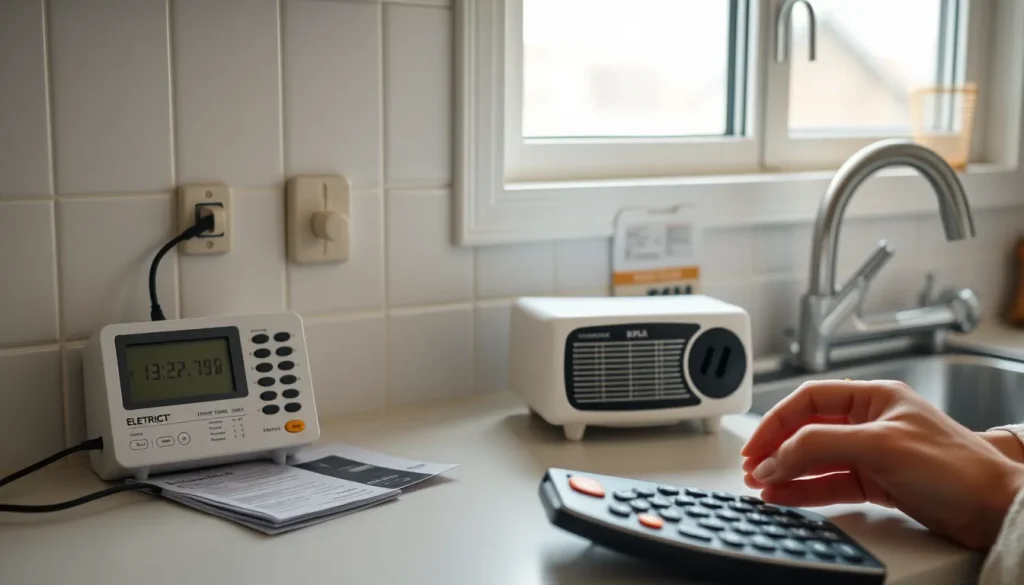
A bill payer comparing a 1,500-watt space heater with a monthly usage figure of 700 kWh is looking at two different measurements. One describes power at an instant; the other accumulates energy over a billing period. The distinction explains why appliance labels, utility meters, and rate schedules do not all use the same unit.
Power and energy: the difference between kW and kWh
A watt is a measure of power. One kilowatt (kW) equals 1,000 watts, according to the U.S. Energy Information Administration. Power describes the rate of electricity use or production at a given moment. A 1,000-watt microwave running at full power draws about 1 kW while it is operating; a 100-watt fan draws about 0.1 kW.
A kilowatt-hour (kWh) is a measure of energy. It is the amount of electricity that one kilowatt used for one hour represents. The North Carolina Public Staff illustrates the idea with a 100-watt light bulb: running it for 10 hours uses 1 kWh. Kootenai Electric Cooperative uses a water analogy: kW is like the flow through a hose at a moment, while kWh is like the water collected in a bucket over time.
The basic relationship is:
energy in kWh = power in kW × time in hours
So a device that runs steadily at 2 kW for 3 hours uses 6 kWh. A device that runs at 1.5 kW for 30 minutes uses 0.75 kWh, because 30 minutes is 0.5 hour. This multiplication is why a high-power appliance used briefly can use less energy than a lower-power appliance left on for many hours.
Why an electricity bill is usually charged in kWh
An electricity meter accumulates energy over a billing period. For a standard residential energy charge, the utility multiplies the metered kWh by a price per kWh. The North Carolina Public Staff describes the energy charge as the part of the bill that recovers costs associated with electricity consumption. A basic customer charge is separate and is generally fixed for having service, so it does not rise simply because one more lamp is switched on.
That does not mean every charge on every bill is a simple kWh charge. Bills can include fixed customer charges, taxes, riders, tiered rates, time-of-use rates, and, on some rate designs, demand charges. A demand charge is based on the highest rate of power use—kW—during a billing period rather than total energy use in kWh. Demand charges are more common on larger commercial and industrial accounts, but rate designs vary, so a household should read its own tariff instead of assuming that a kWh-only estimate represents the full bill.
Reading the numbers on an electricity bill
Three figures are especially useful when checking a bill:
- Metered usage in kWh: the energy accumulated during the billing period.
- Price per kWh: the rate applied to usage, which may vary by season, tier, or time of day.
- Fixed and other charges: customer charges, riders, taxes, and fees that are not simply usage × rate.
A simplified usage charge is:
usage charge = kWh × price per kWh
For example, 700 kWh at an illustrative price of $0.15 per kWh gives a usage charge of $105. That figure is not the whole bill if fixed charges, taxes, or riders apply. It also may not equal the cost of adding one more kWh if the household is on a tiered or time-of-use rate.
The effective average rate is the total bill divided by total kWh. It is useful for describing the overall bill, but the marginal price—the price of the next kWh—is more relevant when estimating the cost of running an extra appliance. On a tiered plan, for instance, extra use may fall into a higher-priced tier. On a time-of-use plan, the hour of use changes the price.
Worked example: estimating a space heater’s energy use and cost
Suppose a household wants to estimate a 1,500-watt portable space heater. The following inputs are illustrative assumptions, not a typical household’s measured usage: the heater runs at full power for 4 hours per day, the month has 30 days, and electricity costs $0.14 per kWh. Fixed charges, taxes, and fees are excluded.
- Convert watts to kilowatts:
1,500 ÷ 1,000 = 1.5 kW. - Multiply by daily operating hours:
1.5 kW × 4 hours = 6 kWh per day. - Multiply by days in the period:
6 kWh × 30 days = 180 kWh. - Multiply by the price per kWh:
180 kWh × $0.14 = $25.20.
If the heater’s thermostat cycles it on and off so that it runs at full power only half the time, the modeled energy falls to about 90 kWh, and the modeled usage cost falls to about $12.60 under the same illustrative price. Real consumption depends on room size, outdoor temperature, insulation, thermostat setting, and how often the unit cycles.
| Operating assumption | Effective full-power hours per day | Energy in kWh | Modeled usage cost |
|---|---|---|---|
| Continuous at 1.5 kW for 4 hours per day | 4.0 | 180 | $25.20 |
| Cycles at 50% during the same 4-hour period | 2.0 | 90 | $12.60 |
The table shows why a nameplate wattage alone does not establish average consumption. A label may state maximum power, while the appliance may run intermittently. For appliances with variable power—such as heat-pump systems, some refrigerators, and inverter-driven equipment—a plug-in meter or manufacturer energy-use documentation is more reliable than multiplying the label wattage by hours.
Where kW appears besides the usage line
Power in kW also appears in places that are not the bill’s kWh usage line. An electric vehicle charger may be rated in kW; a backup battery may list both a power rating in kW and a capacity in kWh; a generator may be rated in kW. For a battery, the kW rating describes how much power it can deliver at once, while the kWh rating describes stored energy. A 10 kWh battery with a 5 kW output could, in a simple ideal calculation, run a 5 kW load for about 2 hours, but usable capacity, efficiency losses, and reserved backup capacity usually reduce that runtime.
Appliance buyers encounter the same distinction. A higher-wattage appliance may heat water or cook faster, but it may also draw more power while operating. A yellow EnergyGuide label, where available, typically expresses estimated annual energy use in kWh and can help compare models on energy use rather than power alone. The label’s assumptions about use may not match a particular household.
How to estimate an appliance’s kWh and cost
- Find the operating power. Use the manufacturer’s wattage, the appliance label, or a plug-in electricity monitor. Do not open or modify hardwired equipment; consult a qualified professional when needed.
- Convert watts to kW. Divide watts by 1,000.
- Estimate hours per day and days in the period. Use the same period as the bill or rate you are comparing.
- Calculate energy.
kWh = watts ÷ 1,000 × hours per day × days. - Apply the relevant price per kWh. Use the marginal rate when possible, and state whether fixed charges and taxes are excluded.
- Adjust for cycling or variable power. Prefer measured kWh from a monitor; otherwise label any duty-cycle assumption clearly.
Renters can often use a plug-in monitor on a compatible 120-volt appliance, provided the monitor is rated for the load. Homeowners may have more options for circuit-level monitoring, but hardwired appliances and panel work should be handled by qualified professionals. For either group, the most defensible estimate uses measured kWh over a representative period rather than a single label rating.
Common mistakes when comparing kW and kWh
- Treating kW and kWh as synonyms. A 1.5 kW heater does not use 1.5 kWh unless it runs for exactly one hour at full power. The correction is to multiply power by time.
- Using nameplate watts as average demand. This overestimates cycling appliances. Use a meter or a clearly stated duty cycle.
- Forgetting to divide watts by 1,000. Entering 1,500 as kW instead of 1.5 kW multiplies the result by 1,000.
- Comparing bills with different numbers of days. Usage and fixed charges accumulate over the billing period. Compare equivalent billing days and separate usage changes from rate or fee changes.
- Using the total-bill average rate for an extra appliance. Tiered or time-of-use pricing can make the next kWh cost more or less than the average. Check the marginal price.
What to do next
To resolve a bill question, collect the metered kWh, the number of billing days, the price per kWh, and the fixed charges for two comparable periods. To estimate one appliance, measure its kWh with a plug-in monitor or use the formula above with explicit assumptions. If the goal is to compare appliances, compare estimated annual kWh or measured kWh for equivalent service, then apply the household’s own marginal electricity price rather than a national average.
FAQ
Is a kWh the same as a kW?
No. A kW measures power, or the rate of electricity use at a moment. A kWh measures energy, or the amount used over time. One kW used for one hour equals 1 kWh.
Why does my bill use kWh if my appliance label says kW?
The appliance label typically states power draw, while the meter records energy accumulated over the billing period. To connect the two, multiply the appliance’s kW by its operating hours.
Are demand charges common on residential electricity bills?
Rate designs vary. Many standard residential bills present energy and fixed charges, while demand charges are more common on larger commercial and industrial accounts. A household should check its own bill and tariff for any kW-based charge.
How do I estimate cost if an appliance cycles on and off?
Use a plug-in meter to measure actual kWh when practical. Otherwise, calculate the continuous full-power estimate and then multiply by a clearly stated duty cycle, such as 50% runtime, while treating that result as an assumption rather than a measurement.
Follow the evidence
Sources & references
- North Carolina Public Staff, Understanding Your Electric Bill, https://publicstaff.nc.gov/public-staff-divisions/energy-division/electric-section/understanding-your-electric-bill, retrieved November 5, 2026.
- U.S. Energy Information Administration, Electricity explained: Measuring electricity, https://www.eia.gov/energyexplained/electricity/measuring-electricity.php, retrieved November 5, 2026.
- Kootenai Electric Cooperative, What’s the Difference? kW vs. kWh, https://www.kec.com/faqs/whats-the-difference-kw-vs-kwh/, retrieved November 5, 2026.
Useful terms in this guide
- Power (kW)
- The rate at which electricity is used or produced at a particular moment, measured in kilowatts.
- Energy (kWh)
- The accumulated amount of electricity used over time, measured in kilowatt-hours.
- Demand charge
- A bill component based on the highest rate of electricity use during a billing period, measured in kW.
- Duty cycle
- The share of time an appliance actually operates or runs at full power during a period.
Have a question about these numbers?
Tell us what needs a closer look.