The quick answer
Heat pump running costs change with outdoor temperature because colder air usually increases the heat a home needs while reducing the heat pump’s efficiency, often called COP. The bill effect is weather, system capacity, backup heat, controls, building conditions, and electricity rate combined—not a single fixed cost per hour.
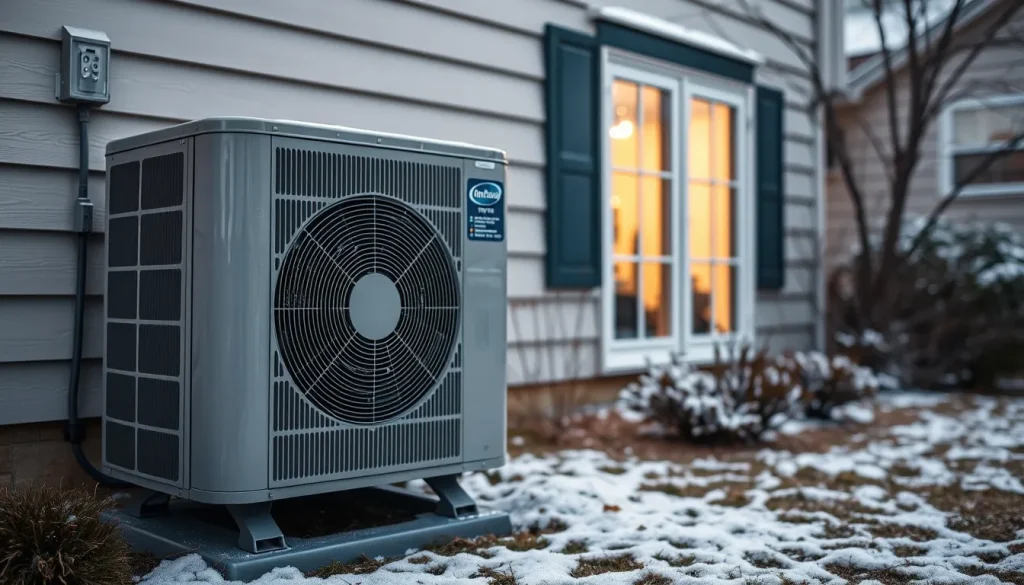
A heat pump’s running cost is not a single number that stays the same all winter. It changes because outdoor temperature changes both sides of the cost equation: the house needs more heat, and the heat pump may need more electricity to deliver each unit of that heat. That is why two months with the same thermostat setting can produce very different kWh totals and bills.
The direct answer: colder air usually means lower efficiency and higher heat loss
Heat pumps move heat rather than making it by burning fuel. Their efficiency is usually described by COP, the coefficient of performance: heat output divided by electricity input. A COP of 3 means the system delivers about 3 kWh of heat for each 1 kWh of electricity, under the stated conditions. As outdoor air gets colder, there is less usable heat to move, and the compressor and outdoor unit have to work harder. iDM Energiesysteme explains that outdoor temperature is one of the most influential factors in heat pump efficiency because the source temperature directly affects how much electrical energy is required. EPRI’s cold-climate brief makes the same practical point: heat pump heating capacity is reduced at lower outdoor temperatures—precisely when a home’s heating load is highest.
The result is not a straight-line increase. A modest drop in outdoor temperature can have a small effect in mild weather and a larger effect near the system’s cold-weather limit. The building also matters: a leaky house gains heat more slowly and loses it faster, so the heat pump runs longer. Running cost reflects both delivered heat and efficiency.
Why the bill can rise faster than the outdoor temperature falls
Two curves move in opposite directions. As outdoor temperature falls, the home’s heat loss increases, so the amount of heat the system must deliver increases. At the same time, the heat pump’s capacity and COP often fall. The system may run longer, cycle differently, or—on some setups—call on auxiliary resistance heat. When resistance backup runs, it can use roughly one unit of electricity per unit of heat, much less efficient than normal compressor operation. Not every system uses resistance backup in the same way, and some cold-climate models are designed to keep running at lower temperatures, but the general relationship is why cold snaps can show up sharply on a bill.

Defrost is another weather-related factor. In cold, damp conditions, frost can form on the outdoor coil. The system periodically reverses or adjusts operation to melt it. That is normal, but it uses energy and temporarily changes how much heat is delivered indoors. Homes with poorly sealed ducts or an outdoor unit blocked by snow or ice can see additional runtime.
The calculation: from delivered heat to electricity to dollars
A transparent estimate needs three inputs: the heat delivered over the period, the average COP over that same period, and the price of electricity. The calculation is:
electricity_kWh = delivered_heat_kWh / COP
variable_cost = electricity_kWh × price_per_kWh
Delivered heat is measured in kWh of heat, not kWh of electricity. COP is unitless. Price per kWh should be the marginal or usage rate that applies to the extra electricity, not the total bill divided by total kWh if fixed charges are included. A complete bill can also include fixed fees, taxes, demand charges, and time-of-use pricing, none of which this simple formula captures.
Seasonal average COP is often more useful than a single outdoor-temperature COP. SCOP is a seasonal efficiency metric that averages performance across a heating season at four test temperatures under the European EN 14825 standard. In North America, HSPF is the common heating metric. Reading Heat Pumps notes that HSPF is not directly interchangeable with EN 14825 SCOP; because HSPF is tested in a warmer U.S. climate, a direct conversion requires roughly a 20–30% derating. That does not make one metric useless—it means you should compare like with like and not treat a single rating as a household bill prediction.
Worked example: same house, different weather-driven COP
The following is an illustrative calculation, not a typical household result or a current price quote. Suppose a home needs 10,000 kWh of heat over a heating season, the electricity usage rate is $0.18 per kWh, and fixed charges and taxes are excluded. The table varies only the average COP to isolate the efficiency effect.
| Delivered heat (kWh) | Average COP | Electricity used (kWh) | Variable cost at $0.18/kWh |
|---|---|---|---|
| 10,000 | 3.5 | 2,857 | $514 |
| 10,000 | 2.5 | 4,000 | $720 |
| 10,000 | 2.0 | 5,000 | $900 |
At an average COP of 3.5, the home uses about 2,857 kWh of electricity and pays about $514 at the illustrative rate. At an average COP of 2.5, the same 10,000 kWh of heat requires 4,000 kWh and costs $720. That is $206 more, or about 40% more, for the same delivered heat. In a real cold snap, delivered heat would also rise because the house loses more heat, so the bill effect can be larger than the COP-only comparison.
The table also shows why a single cold month can distort a seasonal average. If most of the season runs at a mild-weather COP but a few weeks run at a much lower COP, the monthly bill can jump even if the seasonal SCOP label has not changed. The label describes a standardized season; the bill describes actual weather, building conditions, controls, and rates.
What SCOP, COP, and HSPF can and cannot tell you
COP is a snapshot at a stated condition. SCOP is a seasonal average under a defined test method. HSPF is a North American seasonal metric, but its test climate differs. A higher number generally indicates better efficiency under the test, but no rating can tell you exactly what a particular house will use in a particular winter. Installation quality, sizing, duct design, refrigerant charge, thermostat settings, and maintenance can change real-world performance. EPRI’s cold-climate research focuses on technology advances and adoption barriers because cold-climate performance is not just a laboratory rating issue; it affects capacity, backup heat, and customer experience.
The European Heat Pump Association notes that heat pumps can be three to five times as efficient as a fossil fuel boiler but cost more to buy and install, so payback depends on running costs and tariffs. That is another reason a seasonal efficiency label, a weather forecast, and a bill cannot be treated as the same thing.
For an appliance buyer, compare products using the same metric and ask how the system performs at the winter temperatures that matter locally. A standard efficiency rating may be adequate in a mild climate and a poor guide in a colder one. For a bill payer, the more useful question is not “What is the COP?” but “How many kWh did the system use, and how much of that was compressor operation versus backup heat?”
Other reasons two winter bills can differ
Outdoor temperature is central, but it is not the only variable. A higher bill can also come from:
- More heating degree days. A colder billing period requires more heat even if the thermostat setting is unchanged.
- Longer billing periods. A 35-day bill is not comparable with a 28-day bill without adjusting.
- Rate changes. A new rate, time-of-use period, or seasonal price can raise the dollar total while kWh stays flat.
- Fixed charges and fees. These can make the effective average price per kWh look different from the marginal price of extra usage.
- Thermostat schedule and setbacks. Recovery from a setback can call for more capacity, and some systems may use backup heat during recovery depending on settings.
- Filters, ducts, and maintenance. Restricted airflow or leaky ducts can increase runtime and reduce delivered comfort.
- Occupancy and hot water. More people at home, more showers, or an integrated water-heating mode can add load that is not space heating.
This is why a weather-only explanation can be incomplete. The strongest bill diagnosis compares kWh, billing days, and weather over equivalent periods before attributing the change to the heat pump alone.
How to check your own weather effect
Start with usage, not dollars. Collect two or three billing periods with the number of days and kWh used. If your utility provides heating degree days or daily usage, compare kWh per degree day rather than raw monthly totals. Then check whether the heat pump’s auxiliary heat has been running more than usual; some thermostats report auxiliary runtime, and a qualified HVAC technician can verify changeover or balance-point settings. Finally, separate the usage charge from fixed fees and taxes so you are comparing the same part of the bill.
A simple checklist:
- Record billing start and end dates and the number of billing days.
- Record kWh used, not just the dollar total.
- Note the outdoor temperature pattern or heating degree days for the same period.
- Check thermostat history and auxiliary heat runtime if available.
- Compare the usage rate and any time-of-use periods.
- Look for non-weather loads such as hot water, space heaters, or added occupancy.
If kWh rose but the rate and billing days were similar, weather, runtime, or backup heat are likely contributors. If kWh was flat but the bill rose, rate or fee changes are more likely. Neither conclusion is a confirmed diagnosis without checking the underlying data.
Practical implications
For renters, the useful actions are low-cost and reversible: keep filters clean if the landlord permits, keep supply and return vents clear, use a programmable or smart thermostat conservatively, and ask the utility for usage data. Do not open refrigerant lines or adjust equipment internals. For homeowners, air sealing and duct sealing can reduce heat loss and make any heat pump run less. When replacing a system, ask for a load calculation, a cold-climate capacity statement, and a clear explanation of how backup heat is controlled. For appliance buyers, compare efficiency metrics only within the same test framework and treat installed performance as a system issue, not just a box rating.
Running costs change with outdoor temperature because heat demand and heat pump efficiency change together. The bill is the product of both, plus rates and fees. The next step is to compare equivalent billing periods in kWh and weather, then use that evidence to decide whether the issue is weather, backup heat, building performance, or the tariff.
FAQ
Does a heat pump always cost more to run in winter?
No. A heat pump can remain efficient in cold weather, and costs depend on local climate, system design, electricity rate, thermostat settings, and building conditions. But colder outdoor air usually raises heating load and can lower COP, so winter running costs often rise compared with mild weather.
Why did my heat pump use more kWh without a thermostat change?
Colder outdoor air increases heat loss from the home, so the system must deliver more heat. It may also run at a lower COP, run longer, or use more auxiliary heat during defrost or capacity shortfalls. Billing days and rate changes should be checked separately.
Is HSPF the same as SCOP?
No. HSPF is a North American seasonal heating metric, while SCOP is based on the European EN 14825 test method. Because HSPF is tested in a warmer U.S. climate, it cannot be directly converted to EN 14825 SCOP without roughly a 20–30% derating.
What COP should I expect at a given outdoor temperature?
There is no single answer because COP varies with outdoor temperature, indoor supply temperature, defrost, controls, and installation. A manufacturer’s single COP figure is a snapshot, not a guarantee of seasonal household performance. Seasonal metrics and actual kWh use are more useful for bill comparisons.
Follow the evidence
Sources & references
- EPRI, Quick Insight: Cold Climate Heat Pumps, https://restservice.epri.com/publicdownload/000000003002020864/0/Product (no publication date shown in supplied result).
- iDM Energiesysteme, Outdoor Temperature & Heat Pump Efficiency | COP Impact, https://www.idm-energie.at/en/heat-pump-efficiency/outdoor-temperature/ (no publication date shown in supplied result).
- European Heat Pump Association, How much does my heat pump cost to run?, 23 Aug 2024, https://ehpa.org/news-and-resources/news/how-much-does-my-heat-pump-cost-to-run/
- Reading Heat Pumps, SCOP, COP and HSPF explained — heat pump efficiency, last reviewed 14 May 2026, https://readingheatpumps.uk/guides/scop-cop-hspf-explained/
Useful terms in this guide
- COP
- Coefficient of performance: heat delivered divided by electricity used at a given condition.
- SCOP
- Seasonal coefficient of performance: an average efficiency figure for a heating season under a defined test method.
- HSPF
- Heating Seasonal Performance Factor: a North American seasonal heating efficiency metric with a different test climate from SCOP.
- Auxiliary heat
- Backup heating, often electrical resistance, used when a heat pump cannot meet the load or during defrost and recovery.
Have a question about these numbers?
Tell us what needs a closer look.