The quick answer
For larger amounts, an electric kettle is generally the cheaper electric method for heating water; a microwave can use less energy for a single mug when it heats only the water needed. The difference is often pennies per use, and overfilling or reboiling the kettle usually wastes more than switching appliances.
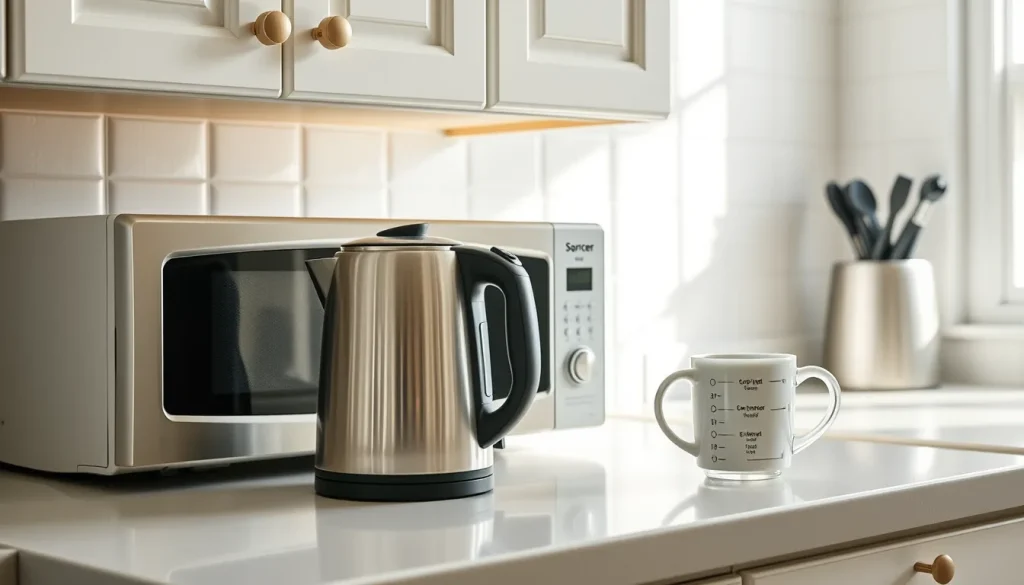
Heating water is one of the few kitchen jobs where the physics is simple and the shopping advice is often oversold. A kettle and a microwave both turn electricity into heat, but they deliver that heat differently, and the amount of water you heat usually matters more than the machine you choose. The useful question is not which appliance is always cheaper; it is which appliance is cheaper for the volume you actually need.
What actually drives the cost of heating water
Electricity is billed in kilowatt-hours, not watts. A watt is a rate of power, while a kilowatt-hour is energy used over time. The basic formula is energy_kWh = watts / 1000 × hours, and the cost is energy_kWh × price_per_kWh. A 1,500-watt kettle running for four minutes uses 1.5 × 4/60 = 0.1 kWh, for example. At an illustrative rate of $0.17/kWh, that is about 1.7 cents.
For water heating, the useful energy depends mainly on volume and temperature rise. Selectra reports that heating 1 liter of water from cold tap temperature to boiling needs roughly 0.093 kWh before appliance losses. At $0.17/kWh, the ideal energy cost is 0.093 × 0.17 = $0.0158, or about 1.6 cents. Real appliances use more because heat escapes, the container absorbs some energy, and the heating process is not perfectly efficient. Your actual rate, starting water temperature, and appliance design can all change the result.
Electric kettle vs microwave: how each heats water
An electric kettle usually places a heating element in direct contact with the water. That design is fast and can be efficient, but the kettle heats every drop you put in it, including water you do not need. Many kettles also have a minimum fill mark, which can encourage people to boil more water than one mug requires.

A microwave heats water inside a container using electromagnetic waves. It can heat a small portion quickly, which is useful for one mug, but it can be less efficient per liter of water than a kettle. HomeBillCuts estimates a corded electric kettle at about 2 cents per liter at $0.17/kWh, while microwaves trailed by roughly a fraction of a cent to about 1.5 cents per liter depending on the comparison. That does not make the microwave a bad choice; it means the microwave is most competitive when it avoids heating unused water.
It is also worth debunking a common shopping claim. Get Energy Savvy notes that all electric kettles are very similar in efficiency and that there is no meaningful low-energy kettle upgrade. A higher-wattage kettle may boil faster, but watts alone do not tell you the cost per liter. The amount of water and the losses during heating matter more.
Worked example: one liter and one mug at an illustrative rate
The following is an illustrative calculation, not a current price quote. It uses $0.17/kWh to show the arithmetic. Your utility rate may be lower or higher, and taxes, fixed charges, and time-of-use pricing are excluded.
- Energy needed for 1 liter: about 0.093 kWh before losses.
- Illustrative rate: $0.17/kWh.
- Ideal energy cost for 1 liter: 0.093 × $0.17 = $0.0158, or about 1.6 cents.
- Kettle cost used here: about 2 cents per liter at $0.17/kWh, based on HomeBillCuts. That implies roughly 0.118 kWh per liter: $0.02 / $0.17 = 0.1176 kWh.
- Microwave cost used here: roughly 2.1 to 3.5 cents per liter, reflecting the source range that microwaves trail kettles by a fraction of a cent to about 1.5 cents per liter.
For 8 ounces, about 0.24 liter, a kettle heating only that amount costs about 0.5 cent. A microwave heating the same amount costs roughly 0.5 to 0.9 cent. The difference is less than a cent. But if the kettle is filled to 1 liter for a single 8-ounce mug, the kettle costs about 2 cents while the microwave still costs roughly 0.5 to 0.9 cent. That is the main scenario in which the microwave clearly uses less energy: it heats only the water needed.
Scenario comparison
| Task | Water heated | Kettle cost | Microwave cost | Practical reading |
|---|---|---|---|---|
| One 8-ounce mug, kettle measured to 8 ounces | About 0.24 liter in each appliance | About 0.5 cent | About 0.5 to 0.9 cent | Difference under a cent; choose convenience and safety. |
| One 8-ounce mug, kettle filled to 1 liter | 1 liter in kettle; 0.24 liter in microwave | About 2 cents | About 0.5 to 0.9 cent | Microwave uses less energy because the kettle heats unused water. |
| Four 8-ounce mugs, about 1 liter total | 1 liter | About 2 cents | About 2.1 to 3.5 cents | Kettle is usually cheaper and faster for the full liter. |
When the microwave is the better choice
- You need one mug and can heat only that amount in a microwave-safe vessel.
- Your kettle has a high minimum fill mark or you tend to overfill it out of habit.
- You do not need a rolling boil for the full amount and can stir the water before use.
- You want to avoid buying or storing a separate electric kettle.
Microwave heating can be uneven, so stir the water and let it stand briefly before drinking. Use a microwave-safe mug and follow the appliance instructions. Water can become superheated in a smooth container and erupt when disturbed, so avoid overheating and do not add powders or objects immediately after heating without allowing the water to settle.
When the electric kettle is the better choice
- You regularly make several cups, a tea pot, pour-over coffee, instant noodles, or cooking water.
- You want faster heating for a full liter and a simple pouring spout.
- You can fill to a marked level and avoid boiling more than you need.
- You prefer a appliance with a predictable shutoff and no need to transfer hot water from a mug.
The kettle is usually the cheaper electric method per liter in the supplied comparisons. A UK source also found that a gas hob could be slightly cheaper per mug than an electric kettle, but it took much longer. U.S. gas rates, venting, and cooking habits differ, so that result should not be transferred directly to a U.S. kitchen without checking your own fuel cost and appliance setup.
Common mistakes that cost more than the appliance choice
- Overfilling the kettle. Boiling a full kettle for one cup can waste more energy than the difference between a kettle and a microwave. Use the fill markings or a measuring cup.
- Reboiling a full kettle. Reheating water you did not use repeats the energy cost. Boil only what you need for the next task.
- Assuming lower wattage means lower cost. A lower-wattage microwave may simply run longer. Compare kilowatt-hours and time for the same volume.
- Comparing different volumes. A microwave heating one mug is not directly comparable with a kettle heating a liter. Use the same starting temperature and amount of water.
- Ignoring microwave safety. Use microwave-safe containers, avoid superheating, and allow hot water to stand before handling.
Assumptions, limits, and how to estimate your own cost
The supplied comparisons are UK-focused, although the physics and the general pattern carry over. U.S. results depend on your marginal electricity rate, kettle wattage, microwave wattage, starting water temperature, kettle minimum fill, container shape, altitude, and how often you overfill. The estimates above exclude fixed monthly charges, taxes, and demand charges. If you are on a time-of-use plan, the relevant price is the rate in effect when you heat the water.
To estimate your own cost, use this sequence:
- Find your marginal electricity rate in dollars per kWh. Divide cents per kWh by 100 if needed.
- Measure the water you actually heat. One U.S. cup is about 0.24 liter; 1 liter is about 4.2 cups.
- Time the appliance for that amount, or use a per-liter estimate if you have one.
- Calculate energy:
watts / 1000 × hours. Then multiply by your rate. - Compare the same volume and starting temperature. A fair comparison is 8 ounces in the kettle versus 8 ounces in the microwave, not 1 liter versus 1 mug.
A practical next step is to measure your usual kettle fill for one week. If you routinely boil a liter for one or two mugs, try heating only the needed amount in the microwave or fill the kettle to the mug level. If you usually make several cups at once, keep using the kettle and focus on descaling it and avoiding reboils. Those habits are likely to matter more than replacing one appliance with the other.
FAQ
Is it cheaper to boil water in a microwave or an electric kettle?
A kettle is usually cheaper per liter, but a microwave can use less energy for one mug if it heats only the needed water and the kettle would otherwise be overfilled. The difference is often pennies per use, so avoid overfilling and reboiling first.
Does a lower-wattage microwave use less electricity?
Not necessarily. Energy use depends on watts multiplied by time, plus efficiency. A lower-wattage microwave may run longer to heat the same water. Compare kilowatt-hours for the same volume and starting temperature.
Is it safe to boil water in a microwave?
Yes, with a microwave-safe container and normal precautions. Water can become superheated and erupt, so avoid overheating, follow the appliance instructions, and let the water stand briefly before stirring or adding anything.
How much does it cost to boil 1 liter of water?
The ideal energy needed is about 0.093 kWh. At an illustrative $0.17/kWh, that is about 1.6 cents before losses; a kettle is commonly around 2 cents per liter under the same illustrative rate. Your own cost scales with your electricity rate and appliance efficiency.
Follow the evidence
Sources & references
- Selectra. Kettle, microwave or saucepan: which is the cheapest and quickest way to boil water? Updated November 4, 2026. https://selectra.co.uk/energy/news/kettle-microwave-pan-cheapest-boil-water
- Get Energy Savvy. Are kettles king at boiling water? Updated October 4, 2024. https://www.getenergysavvy.info/post/kettles-really-are-the-best-way-to-boil-water
- HomeBillCuts. Electric Kettle vs. Stove vs. Microwave: What Does It Really Cost to Boil Water? Updated October 14, 2026. https://homebillcuts.com/blog/electric-kettle-vs-stove-microwave-cost-to-boil-water/
Useful terms in this guide
- Kilowatt-hour (kWh)
- A unit of energy equal to using 1,000 watts for one hour; utilities use it to bill electricity.
- Marginal electricity rate
- The price of the next kilowatt-hour you use, which is the appropriate rate for estimating an extra appliance use; it may differ from your bill's average rate.
- Superheating
- A microwave hazard in which water can rise above its boiling point without bubbling and then erupt when disturbed.
Have a question about these numbers?
Tell us what needs a closer look.