The quick answer
A refrigerator typically draws roughly 300–800 watts while its compressor is running, but it does not run continuously. Its daily energy use is often much lower—about 1–2 kWh per day in one reported range—so the bill depends on kilowatt-hours used and the household’s electricity rate.
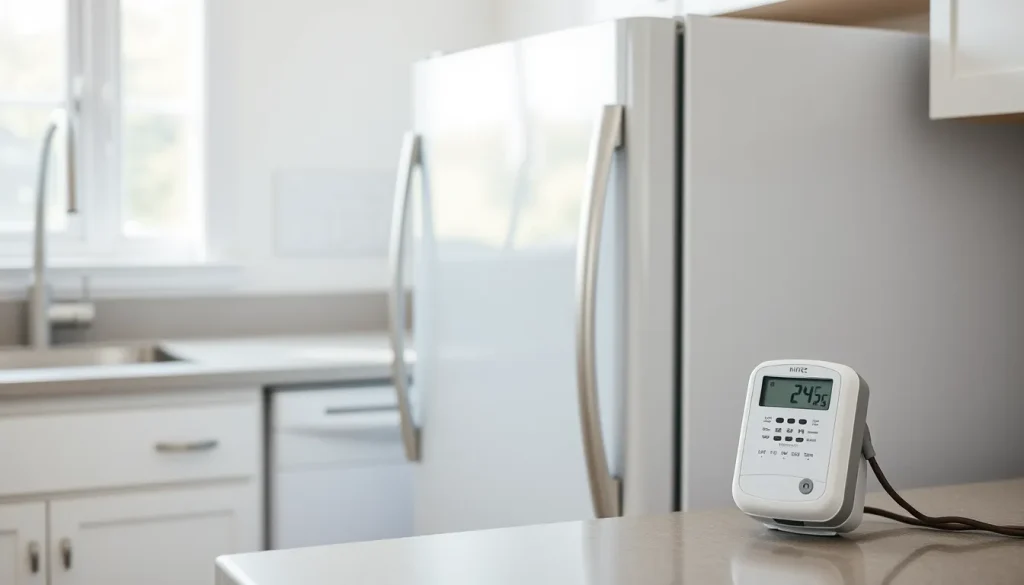
A refrigerator is unusual among large appliances: its compressor switches on and off, so the wattage on a specification sheet is not the same as the energy it uses over a month. To answer the bill question, separate power from energy, use kilowatt-hours as the basis, and then apply the household’s electricity rate.
How much electricity does a refrigerator use?
EnergySage reports that refrigerators use roughly 300 to 800 watts of electricity on average, while noting that actual energy use is typically much less than the stated wattage because the appliance cycles on and off. Schneider Electric gives the same 300–800 watt range for a standard refrigerator/freezer combination. Those figures describe power draw while the compressor is running, not a continuous 24-hour load.
For daily energy, a separate source focused on domestic fridges reports typical consumption of about 100 to 250 watts and 1 to 2 kilowatt-hours (kWh) per day. That lower wattage figure reflects average draw over time, including off periods, rather than compressor running power. The difference is a useful warning: quoted wattages from different sources may measure different things.
| Measure | Reported figure | What it tells you |
|---|---|---|
| Running power | About 300–800 W | Instantaneous draw while the compressor runs; not a continuous average. EnergySage and Schneider Electric report this range. |
| Average draw over a day | About 100–250 W in one domestic-fridge source | Lower because the compressor cycles; use with caution outside that source’s scope. |
| Daily energy | About 1–2 kWh per day in that same source | A better starting point for bill estimates than running watts. |
| Source-reported average cost | About $20 per month or $240 per year | EnergySage’s reported average; actual cost depends on rate, appliance, and usage. |
Watts vs. kilowatt-hours: the distinction that prevents overestimating
Power is the rate at which an appliance uses electricity, measured in watts (W) or kilowatts (kW). Energy is the amount used over time, measured in watt-hours (Wh) or kilowatt-hours (kWh). A 500 W refrigerator running nonstop for 24 hours would use 12 kWh:
500 W / 1,000 = 0.5 kW; 0.5 kW * 24 hours = 12 kWh
Most refrigerators do not run the compressor nonstop. They cycle to hold temperature, so the 24-hour figure is usually much lower than the running-wattage calculation. That is why a simple wattage rating cannot be multiplied by 24 without a duty-cycle assumption.
The basic energy formula is:
energy_kWh = watts / 1,000 * operating_hours_per_day * days
For a cycling appliance, operating_hours means equivalent full-power hours, not the hours the fridge is plugged in. A plug-in kWh meter measures those equivalent hours for you.
A worked example for a U.S. household
This example is illustrative, not a prediction for a particular refrigerator. Assume 1.5 kWh per day, a 30-day month, a 365-day year, and an electricity price of $0.16 per kWh for the usage charge. The price is a hypothetical input; use the rate on the household’s bill. Fixed fees, taxes, and other charges are excluded.
Monthly energy: 1.5 kWh/day * 30 days = 45 kWh. Monthly usage charge: 45 kWh * $0.16/kWh = $7.20. Annual energy: 1.5 kWh/day * 365 days = 547.5 kWh. Annual usage charge: 547.5 kWh * $0.16/kWh = $87.60.
| Daily energy | 30-day energy | Monthly usage charge | Annual energy | Annual usage charge |
|---|---|---|---|---|
| 1.0 kWh | 30 kWh | $4.80 | 365 kWh | $58.40 |
| 1.5 kWh | 45 kWh | $7.20 | 547.5 kWh | $87.60 |
| 2.0 kWh | 60 kWh | $9.60 | 730 kWh | $116.80 |
EnergySage reports a higher average cost—about $20 per month, or $240 per year—which illustrates why the household’s rate and appliance matter. The example above is a method, not a contradiction: change the daily kWh or price and the result changes.
What changes a refrigerator’s real-world consumption
Several factors can move actual use up or down:
- Size, type, and features. Electrolux notes that model design, size, and features such as ice makers and dispensers can affect energy use, and that bottom-mounted fridges are generally less energy efficient than top-mounted fridges in its discussion. Those are general design factors, not a guarantee for a specific model.
- Ambient temperature and location. Reduction Revolution notes that a fridge in a warm or poorly ventilated area uses more power, and that refrigerators tend to use more energy in summer than winter. In a U.S. home, a fridge next to an oven or in a hot garage can face a harder workload.
- Door openings and use. Frequent or long door openings make the compressor work harder to recover temperature, according to Reduction Revolution.
- Maintenance and airflow. Schneider Electric recommends cleaning condenser coils and encouraging airflow around the fridge as ways to reduce consumption. Dirty coils or blocked vents can make heat removal less effective.
- Temperature setting and seals. A colder setting and worn door seals can increase runtime. These are general service checks; a qualified appliance technician should handle refrigerant or electrical repairs.
How to estimate your own refrigerator
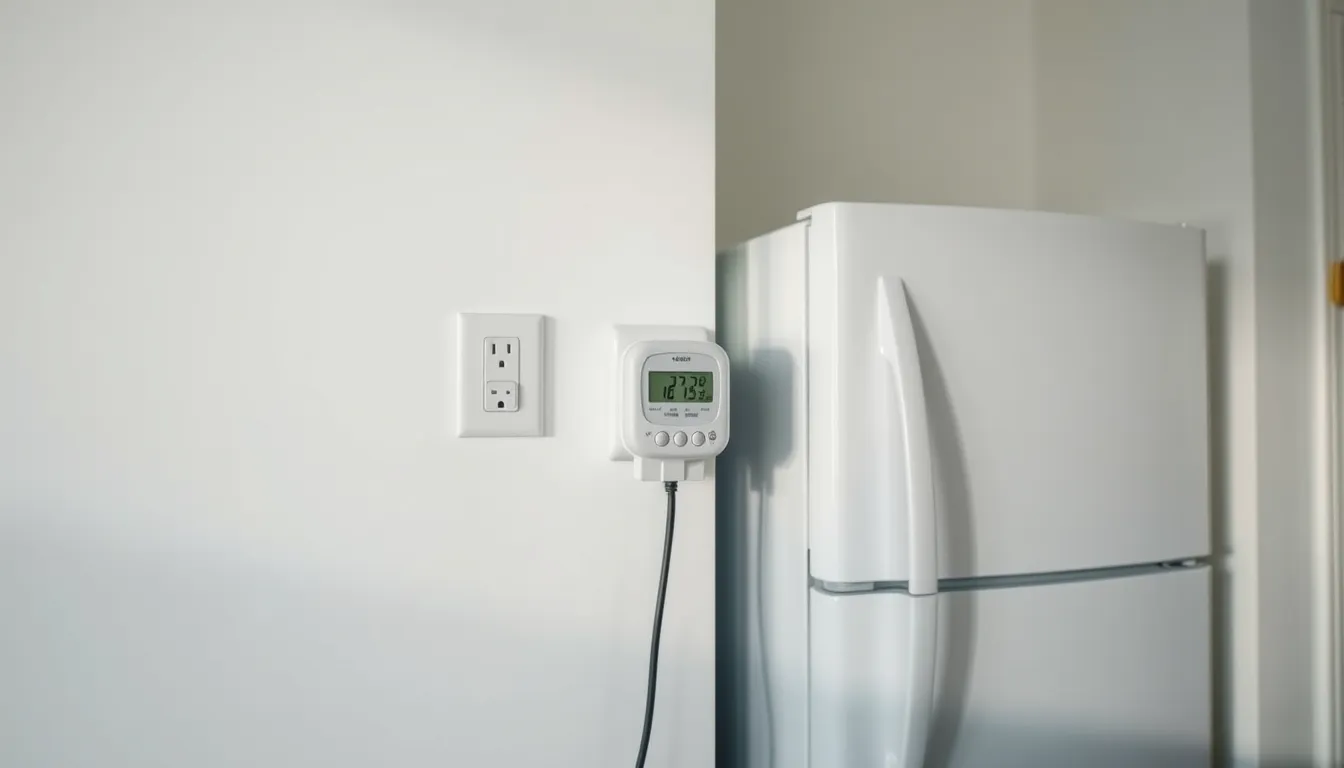
Use measured kWh when possible. A practical sequence:
- Check the EnergyGuide label or manual. Look for estimated annual kWh, not only watts. The annual kWh figure is designed for comparing models under standard test conditions.
- Measure with a plug-in kWh meter. Use a meter rated for the refrigerator’s load. Record energy over 24 hours to a week, including normal door openings. A week captures more variation than a single compressor cycle.
- Convert to billing periods. Use
daily kWh * 30for an approximate 30-day month, ordaily kWh * number of billing daysfor a specific bill. - Apply the right rate. Multiply kWh by the marginal price per kWh. If the bill has tiers, time-of-use periods, demand charges, or fixed fees, a single average rate can misstate the cost of changing refrigerator use.
- Compare equivalent periods. When checking a bill change, separate usage changes from rate or fee changes and compare the same number of billing days.
This method estimates the refrigerator’s usage charge. It does not represent the whole electricity bill, which also includes other appliances, fixed charges, taxes, and any applicable program or rider charges.
Common mistakes when estimating refrigerator cost
- Multiplying running watts by 24 hours. A 500 W fridge does not necessarily use 12 kWh per day; cycling usually lowers daily energy. Use equivalent full-load hours or measured kWh.
- Treating nameplate wattage as average draw. Nameplate or specification wattage can describe a running or maximum condition, not the average over a day.
- Using the total bill’s average price for every added kWh. The effective average rate includes fixed costs; the marginal cost of extra usage may differ under tiered or time-of-use pricing.
- Assuming a lower-wattage fridge always uses less energy. A small, inefficient unit that runs often can use more kWh than a larger, better-insulated model. Compare annual kWh or measured energy.
- Ignoring the measurement period. A few hours during a cool morning can understate a week that includes cooking, door openings, and warm afternoons.
Renter, homeowner, and appliance-buyer notes
Renters can usually measure plug-in energy use, adjust temperature settings, keep the fridge away from heat sources where space allows, and report damaged seals to the landlord. Cleaning coils may require landlord permission or professional service. Homeowners deciding on replacement should compare the old unit’s measured or EnergyGuide annual kWh with the new unit’s estimated annual kWh, then model the difference at their own rate. Purchase price, installation, haul-away, and any repair costs belong in the comparison. Modeled energy savings are not guaranteed bill savings.
Appliance buyers should compare like-for-like capacity and features. A larger refrigerator with an ice dispenser may use more energy than a simpler model, but the annual kWh figure is more useful than a single wattage claim. No single refrigerator type wins for every household; the right choice depends on size, climate, usage, budget, and the local electricity rate.
Assumptions, limits, and a practical next step
The sources cited here use different scopes and regions. The 300–800 W range describes running power for standard refrigerator/freezer combinations in EnergySage and Schneider Electric. The 1–2 kWh/day range comes from a separate domestic-fridge source and should be treated as a reported benchmark, not a U.S. average for every home. The $0.16/kWh example is an illustrative input. Actual consumption depends on the appliance, its condition, the room, the season, and how it is used.
For a reliable answer, read the refrigerator’s EnergyGuide annual kWh or measure it with a plug-in kWh meter for a week. Then multiply the daily kWh by the number of billing days and by the household’s marginal electricity rate. That gives a transparent usage estimate and a better basis for comparing a repair, a settings change, or a new appliance.
FAQ
Does a refrigerator use 300–800 watts all day?
No. That range describes running power while the compressor operates. The compressor cycles on and off, so daily kWh is usually lower. Use a plug-in meter or the EnergyGuide annual kWh figure for a bill estimate.
How many kWh does a refrigerator use per month?
It depends on the appliance and usage. At 1–2 kWh per day, a 30-day month works out to 30–60 kWh. Multiply that by your marginal electricity rate; actual use can fall outside that range.
Why does one source say 100–250 watts and another 300–800 watts?
The figures may measure different things. The higher range can describe compressor running power, while the lower range can reflect average draw over time, including off periods. Daily kWh is the more useful figure for bill estimates.
Can changing the thermostat reduce refrigerator electricity use?
It can affect compressor runtime, but food-safety limits how warm the refrigerator should be. Follow the appliance manufacturer and food-safety guidance, and check door seals and airflow before assuming a setting change will produce a specific savings amount.
Follow the evidence
Sources & references
- EnergySage. How many watts does a refrigerator use? Updated February 24, 2026. https://www.energysage.com/electricity/house-watts/how-many-watts-does-a-refrigerator-use/
- Schneider Electric Blog. Deepjyoti Dutta. How much electricity does a fridge, dishwasher, and an electric car use? We did the math. January 24, 2023. https://blog.se.com/sustainability/2023/01/24/how-much-electricity-does-a-refrigerator-dishwasher-and-an-electric-car-use-we-did-the-math/
- Reduction Revolution. Ryan McCarthy. How Much Power a Fridge Uses - in Watts, Cost & kWh. November 13, 2019. https://reductionrevolution.com.au/blogs/how-to/fridge-power-consumption
- Electrolux Australia. Understanding Fridge Power Consumption: Cost, Wattage. https://www.electrolux.com.au/explore/articles/fridge-electricity-consumption/
Useful terms in this guide
- Watt
- A unit of power that describes the rate of electricity use at a given moment.
- Kilowatt-hour
- A unit of energy equal to using 1,000 watts for one hour.
- Duty cycle
- The share of time a compressor runs, or the equivalent full-power operating time over a period.
- Nameplate wattage
- A wattage rating printed on an appliance label; it may describe a running or maximum condition rather than average daily draw.
Have a question about these numbers?
Tell us what needs a closer look.