The quick answer
To read an electricity bill, start with the billing period and total kWh, then separate fixed charges from variable supply and delivery charges. Divide the total bill by kWh to get your effective rate, but use the per-kWh price of extra usage when estimating savings. Check whether the meter reading was actual or estimated before assuming a rate problem.

A monthly electricity bill is a record of two different things: how much energy the household used and what the utility or supplier charged for it. The total can rise because the house used more kilowatt-hours, because the price of those kilowatt-hours changed, because a fixed fee or tax changed, or because the billing period covered more days. Reading the bill well means separating those causes rather than reacting only to the bottom line.
This guide explains the terms on a U.S. residential electricity bill, shows how to trace the total back to usage and rates, and provides a worked example and a checklist. It focuses on the bill itself. It does not assume a particular state, utility, or tariff; charges, rate structures, and consumer protections vary. The goal is to help a renter, homeowner, or appliance buyer answer a practical question: is this bill explained by usage and published charges, or does it deserve a call to the utility?
The bill has a job: connect meter readings to charges
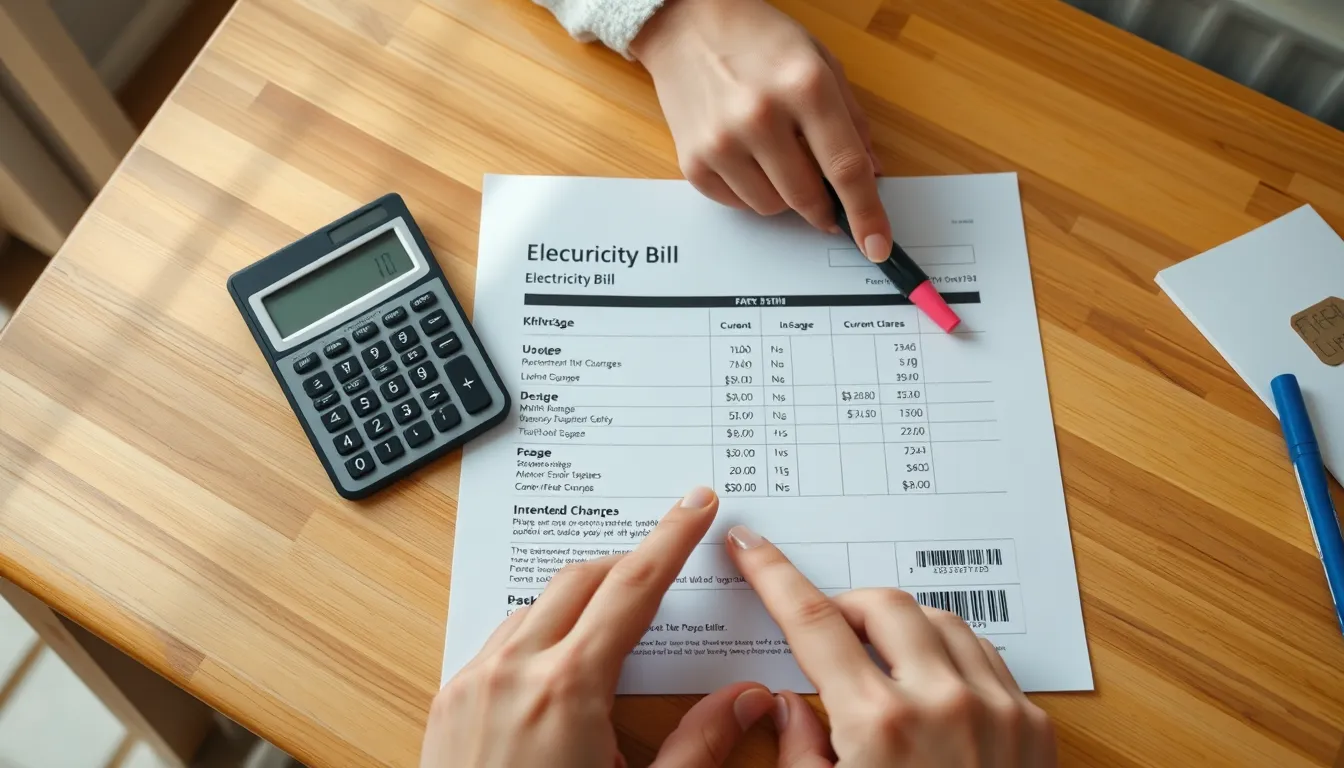
An electricity bill is not one charge. It is a short financial history of a billing period. The header usually identifies the account, service address, meter number, bill date, due date, and the dates covered. The usage section reports the meter reading and the number of kilowatt-hours billed. The charges section converts that usage into money. The messages section may include rate changes, assistance information, or notices about a future meter reading.
Consumer guides commonly group the main bill factors into usage-based charges, fixed monthly charges, and taxes and fees. PIRG explains that usage-based charges depend on how much energy was used, the price of that energy, and the cost of moving electricity from the generator to the utility, while fixed monthly charges and taxes or fees are added separately. The Texas Public Utility Commission similarly lists three common reasons a total amount due may change: household usage changed, natural gas prices or other market factors influenced costs, or the utility’s rates changed. These categories are the backbone of bill reading.
That distinction matters because a bill reader should not compare two totals without comparing the underlying period and quantity. A $160 bill for 28 days and 700 kWh is not directly comparable to a $190 bill for 35 days and 850 kWh. The first question is always: how many days and how many kilowatt-hours am I paying for?
Key terms and units in plain language
Kilowatts measure power; kilowatt-hours measure energy
A kilowatt (kW) is a rate of using or producing power at a moment in time. A kilowatt-hour (kWh) is an amount of energy. One kWh is one kilowatt used for one hour. A 1,500-watt space heater running at full power for two hours uses 3 kWh: 1,500 watts divided by 1,000 equals 1.5 kW, and 1.5 kW times 2 hours equals 3 kWh. The bill charges for kWh, not for the rated wattage printed on a label.
Rated power is not the same as average consumption. A heater cycles on and off. A refrigerator compressor runs part of the time. A television uses less than its maximum label in many viewing conditions. For billing, the useful number is energy over time, preferably measured over the same period as the bill.
The basic relationship is:
energy in kWh = watts / 1,000 × operating hours per day × number of days
Then:
variable charge = energy in kWh × price per kWh
Every input needs a period and a unit. Mixing a daily estimate with a monthly rate, or treating rated watts as continuous use, produces a number that looks precise but is not a bill estimate.
The billing period and the meter reading
Find the dates covered by the bill and count the days. A bill is often described as monthly, but the actual period may be 28, 30, 31, or 35 days depending on the meter-reading schedule. Daily usage is total kWh divided by billing days. Daily cost is total bill divided by billing days. Those two measures make periods more comparable than raw monthly totals.
Check whether the meter reading is labeled actual or estimated. An actual reading comes from a meter read for that period. An estimated reading is based on past use or a utility calculation and can later be corrected when a real reading occurs. If a bill looks unusually high or low, an estimated read is one possible explanation. The next bill may contain a true-up adjustment. A bill reader should not assume a rate increase before checking the reading type.
Many simple cumulative meters show a previous reading and a current reading. Without a multiplier or separate registers, the billed kWh should be the current reading minus the previous reading. More complex meters may have time-of-use registers, demand registers, or multipliers, so the arithmetic is not always plain subtraction. A utility customer service representative can explain the reading if the bill does not.
Supply, generation, delivery, transmission, and distribution
Electricity service has two broad parts. Supply or generation is the energy itself. Delivery, transmission, and distribution are the wires and system that move power to the home. In a fully regulated state, one utility may bundle all of these charges. In a competitive market, a retail supplier may bill for supply while the local wires utility bills for delivery. The labels and business arrangements vary.
The Texas Public Utility Commission notes that it regulates transmission and distribution utility rates in competitive areas of Texas to cover the cost of moving electricity, but it does not set the final price of electricity charged by retail electric providers. That is a useful reminder that a bill can contain both regulated delivery charges and a competitive supply price. A reader should not treat every unfamiliar line as a junk fee. Some lines are the wires charge that pays for the poles, wires, meters, and system maintenance.
If the bill separates supply and delivery, identify each per-kWh price and each fixed portion. The supply price may be a contracted rate, a variable rate, or a rate that changes with market conditions. The delivery price may include a fixed customer charge plus a per-kWh delivery charge. Both matter when comparing offers or explaining a bill change.
Fixed charges, variable charges, and taxes
A fixed charge is a charge that does not change with the number of kWh used during the billing period. It may be called a customer charge, service charge, meter charge, or basic service fee. A variable charge changes with usage, usually expressed in cents per kWh. A bill may also include taxes, riders, surcharges, and regulatory fees. Some consumer guides outside the United States use the term standing charge for a fixed daily charge; the U.S. equivalent is often a monthly customer charge, though terminology differs by utility.
The Energy Ombudsman describes domestic energy bills as typically containing usage charges, standing charges, and taxes. In a U.S. bill, the same idea appears as usage-based supply and delivery charges, a fixed customer charge, and state or local taxes and fees. The names are not standardized. What matters is whether the line changes with kWh or stays the same regardless of use.
Fixed charges deserve attention because they change the effective price of electricity. A household that uses very little electricity may pay a high average rate per kWh simply because the fixed charge is spread over few kilowatt-hours. That does not necessarily mean the rate is bad. It means the bill has a larger fixed component. A low-use household should compare total bills at its own usage, not only the headline cents-per-kWh rate.
Rate designs: flat, tiered, time-of-use, and demand
A flat rate charges the same price per kWh for each unit used. A tiered or inclining-block rate charges one price for the first block of usage, a higher price for the next block, and so on. On a tiered bill, the price of an extra kWh depends on which tier the household is in. A time-of-use rate charges different prices by time of day or season. A demand charge is based on the highest rate of power use in a period, measured in kW, rather than on total kWh. Demand charges are more common on commercial bills, but they can appear on some residential or special rate plans.
These rate designs create two useful prices. The average or effective rate is the total bill divided by total kWh. It tells the household what it paid per kWh overall. The marginal rate is the price of the next kWh or the price of avoiding one kWh. It is the number to use for a savings estimate from turning something off, shifting usage, or improving efficiency. The two can differ because of fixed charges, tiers, time-of-use periods, and taxes.
Credits, adjustments, and past-due amounts
Not every line is a charge. A bill may show a credit for a solar export, a low-income discount, a deposit, a returned payment, or a billing adjustment. It may also show a prior balance, a late fee, or a payment arrangement amount. The current charges for this period are different from the total amount due. A reader should separate new charges from old balances and one-time credits. A bill that looks high because of a past-due balance may have little to do with this month’s electricity use.
How to read your electricity bill, step by step
- Confirm the billing period and due date. Write down the start date, end date, and number of days. Check whether the bill covers a normal month or a longer or shorter interval. A 35-day bill can be higher than a 28-day bill without any change in daily habits.
- Find the total kWh and the reading type. Look for the meter reading section. Note whether the read is actual or estimated. If the bill provides a usage graph, check whether it is monthly kWh, daily kWh, or cost. These are different measures.
- Calculate daily use and daily cost. Divide total kWh by billing days. Divide the current period charges by billing days. Compare those daily figures with the prior month and the same month last year if available. Weather, occupancy, and appliance use can change daily use without any rate change.
- List fixed charges and variable charges separately. Identify the customer charge or service charge. Identify each per-kWh supply and delivery charge. If the bill has a tiered or time-of-use structure, note the tier or period. Do not add a fixed charge into a per-kWh rate unless you are calculating an effective rate for that specific usage level.
- Check the arithmetic where the bill provides enough detail. For a simple cumulative meter, verify that current reading minus previous reading equals billed kWh. Verify that kWh times the stated per-kWh price equals the line charge, allowing for rounding. Check any multiplier or separate register only if the bill explains it. If the numbers do not reconcile, ask the utility to explain rather than guessing.
- Calculate the effective rate. Divide the total current charges by total kWh. This is the all-in average cost per kWh for that bill, including fixed charges and taxes if they are in the total. It is useful for comparing total bills at the same usage level. It is not the price of the next kWh.
- Identify the marginal price of extra usage. On a simple flat rate, add the per-kWh supply and delivery charges. On a tiered bill, use the rate for the tier the household is in. On a time-of-use bill, use the price for the relevant time period. This marginal price is the best simple input for an appliance or behavior savings estimate.
- Scan taxes, riders, and fees. Note any line that is new or unfamiliar. Some are normal system charges. Some are taxes. Some may be late fees or optional services. The bill should describe each charge, but descriptions can be terse. Ask for an explanation of a specific line if it is material to the bill.
- Explain the change before acting. Compare usage, billing days, supply price, delivery price, fixed charges, taxes, and credits against the prior bill. A useful bridge is: change in usage times the marginal rate, plus change in rates times current usage, plus changes in fixed fees and credits. The result will not be exact if tiers or taxes interact, but it separates the main causes.
Worked example: a bill with usage, supply, delivery, fixed fees, and taxes
The following example is illustrative, not a market quote or a typical tariff. Assume a 30-day billing period, 900 kWh used, a supply charge of $0.14 per kWh, a delivery charge of $0.05 per kWh, a fixed customer charge of $12.00, and other fixed fees and taxes of $8.00.
- Supply charge: 900 kWh × $0.14/kWh = $126.00
- Delivery charge: 900 kWh × $0.05/kWh = $45.00
- Variable charges combined: $126.00 + $45.00 = $171.00
- Fixed customer charge: $12.00
- Other fixed fees and taxes: $8.00
- Total current charges: $171.00 + $12.00 + $8.00 = $191.00
The effective rate is $191.00 divided by 900 kWh, which equals about $0.212 per kWh, or 21.2 cents per kWh. The marginal price of one more kWh under these assumptions is $0.14 plus $0.05, or $0.19 per kWh before any tier or tax effect. If usage rose by 100 kWh at the same rates, the variable portion would rise by about $19.00 before taxes. If the supply rate rose by one cent per kWh at the same usage, the supply charge would rise by $9.00. If the fixed customer charge rose by $2.00, the total would rise by $2.00 regardless of usage.
The interpretation is straightforward: the headline supply rate of 14 cents is not the all-in cost. The household paid about 21.2 cents per kWh after delivery, fixed charges, and other fees. But the value of saving one kWh is closer to 19 cents under these assumptions. A reader who uses the 21.2-cent effective rate to estimate the savings from turning off a 1-kWh appliance will overstate the variable saving, while a reader who uses only the 14-cent supply rate will understate the delivery component. Use the effective rate to understand the bill and the marginal rate to estimate changes in usage.
Illustrative bill at three usage levels
The table below holds rates and fixed charges constant so that the effect of usage alone is visible. It uses the same illustrative assumptions: $0.19 per kWh in combined variable supply and delivery charges, a $12.00 fixed customer charge, and $8.00 in other fixed fees and taxes. These are invented example inputs, not current prices or a recommendation.
| Billing period | Usage in kWh | Variable charges at $0.19/kWh | Fixed customer charge | Other fixed fees and taxes | Total bill | Effective rate |
|---|---|---|---|---|---|---|
| Lower-use month | 700 | $133.00 | $12.00 | $8.00 | $153.00 | About $0.219/kWh |
| Base month | 900 | $171.00 | $12.00 | $8.00 | $191.00 | About $0.212/kWh |
| Higher-use month | 1,100 | $209.00 | $12.00 | $8.00 | $229.00 | About $0.208/kWh |
The table establishes two limited points. First, total cost rises with usage when variable rates are positive: each additional 200 kWh adds $38.00 under these assumptions. Second, the effective rate falls as usage rises because the fixed charges are spread over more kilowatt-hours. A higher-use month can have a lower average rate per kWh and still have a higher total bill. That is why bill comparisons should state both usage and total cost.
The table does not establish that one household is on a good or bad tariff. It does not include tiers, time-of-use periods, demand charges, seasonal rates, or changes in taxes. Real bills can behave differently. The purpose is to show the arithmetic and the difference between total cost and average price.
Turning appliance use into kilowatt-hours and bill impact
A bill reader can connect a specific appliance to the bill with a three-step estimate. First, convert rated watts to kilowatts. Second, estimate hours of actual operation over the billing period. Third, multiply by the marginal price of electricity.
For example, assume an illustrative 1,500-watt portable heater runs at full power for 4 hours per day for 30 days. The energy estimate is 1,500 divided by 1,000, times 4, times 30, which equals 180 kWh. At an illustrative marginal price of $0.19 per kWh, the estimated variable cost is 180 kWh times $0.19, or $34.20. If the heater cycles and runs at full power for only 2 hours per day on average, the estimate falls to 90 kWh and $17.10 under the same price assumption.
This is an appliance estimate, not a complete bill. It excludes fixed charges, taxes, and changes in other appliances. It also assumes the heater’s operation is the only change. For a variable-load appliance, measured energy from a meter or smart plug is more reliable than a label. The value of the estimate is that it makes the bill actionable: a reader can compare the estimated kWh with the monthly usage change and see whether an appliance is large enough to explain the difference.
Why the total changed: a diagnostic path
Consumer Reports noted in September 2026 that U.S. residential electric bills had risen by a third on average over five years, citing an analysis by Heatmap, far outpacing inflation. That context makes it tempting to treat every increase as a rate problem. A bill reader should still work through the specific causes in order.
- Usage changed. Weather, occupancy, a new appliance, an electric vehicle, or a change in heating and cooling can raise kWh. The PUCT lists usage as the first common reason a total amount due changes.
- Billing days changed. A longer billing period raises both variable and fixed charges. Compare daily use and daily cost before comparing totals.
- The reading was estimated. An estimated bill can be too high or too low. Check the label and the next reading before treating the total as a permanent change.
- The supply price changed. A variable rate, a contract renewal, or a market-linked supply charge can change the per-kWh price. The PUCT notes that natural gas prices and other market factors can influence electricity prices.
- The delivery or utility rate changed. Regulated delivery charges can change through rate cases. The PUCT explains that it regulates transmission and distribution utility rates in competitive areas to cover the cost of moving electricity, while retail supply prices are set by retail providers.
- The rate structure changed the marginal price. A household may cross into a higher tier, enter a seasonal rate period, or move into a different time-of-use price.
- A fixed fee, tax, rider, or credit changed. These lines can move the total without any change in kWh. A one-time credit that ended can also make the current bill look higher.
- A past-due balance or late fee is included. Separate current charges from the total amount due.
- A billing or meter error is possible but should be tested last. Verify the reading and arithmetic, then ask the utility to explain a specific discrepancy. Do not assume a faulty meter from a high bill alone.
Common mistakes that make bills harder to compare
Comparing total bills with different billing days. A 35-day bill is not a like-for-like comparison with a 28-day bill. Use daily kWh and daily cost.
Using the effective rate for savings estimates. The effective rate includes fixed costs. The marginal rate is the better estimate for the next kWh saved or added. The two can differ substantially at low usage or under tiered rates.
Treating the supply rate as the all-in price. Delivery charges, customer charges, and taxes can add a large share of the total. A supply rate quote is not a complete bill quote.
Ignoring fixed charges when comparing low usage. A plan with a low per-kWh rate but a high fixed charge may cost more for a small household. A plan with a higher per-kWh rate and a low fixed charge may cost less. Compare total cost at the household’s own usage.
Treating budget billing as savings. A level-payment plan smooths seasonal bills. It does not reduce the annual cost by itself. The underlying usage and rates still determine the total over time.
Assuming a high bill means a faulty meter. Usage, weather, estimated reads, rate changes, and billing days are more common explanations. A meter test may be appropriate in some cases, but it should follow a careful bill review.
Forgetting that a rate can change mid-period. A bill may cover days before and after a rate change. The bill should show how the periods were allocated. If it does not, ask.
Overlooking credits and adjustments. A solar credit, low-income discount, or deposit can change the total without changing the cost of electricity used. Read the sign on each line.
What readers can control and what they cannot
Households can influence usage, the timing of some usage, appliance efficiency, thermostat settings, and in some markets the choice of retail supplier. They may qualify for assistance programs, medical protections, or weatherization help. They can also check readings, ask for rate options, and compare total costs at their own usage.
Households generally cannot control fuel prices, regulated delivery rates, state and local taxes, weather, or the fixed customer charge on a given tariff. Those factors belong in the explanation of the bill, not in a self-blame narrative. The practical value of reading the bill is to separate the controllable from the uncontrollable and to avoid making a change that does not address the actual cause.
Regional differences matter. A household in a competitive electricity market may see separate supply and delivery charges and may be able to shop for supply. A household in a fully regulated state may see one bundled tariff. A hot climate may produce summer bills dominated by air conditioning, while a cold climate may show winter heating or heat-pump use. A bill guide cannot substitute for the specific tariff and consumer protections in the reader’s state.
Practical checklist: from bill to decision
Low-cost checks
- Download or gather the last 12 months of bills. Record kWh, billing days, total current charges, and the reading type for each month.
- Calculate daily kWh and daily cost. Compare the same month year over year when possible.
- Verify the current meter reading and the arithmetic shown on the bill.
- List fixed charges separately from per-kWh charges. Identify the supply and delivery components.
- Calculate the effective rate and the marginal rate for the household’s current tier or time period.
- Check whether a new fee, tax, rider, credit, or past-due balance explains part of the change.
- If the bill is estimated, ask when the next actual reading is scheduled and how the true-up will work.
- Ask the utility or supplier for available rate options, assistance programs, and the terms of any contract before switching.
Actions that need more care or a professional
- Before buying a major appliance, compare estimated annual kWh and operating cost at the household’s marginal rate, not just the purchase price.
- Before choosing a time-of-use rate, review usage by hour and confirm that loads can actually be shifted. A rate that rewards evening reduction is not useful if the household cannot shift demand.
- Before signing a retail supply contract, compare the full effective cost at the household’s usage, including fixed fees, cancellation terms, and expiration date. A low headline rate is not a complete comparison.
- For insulation, heating and cooling equipment, electrical panel work, wiring, solar, or battery storage, obtain a professional assessment and itemized quotes. Bill reading can identify a question, but it cannot establish that an upgrade is suitable or safe.
- If a bill appears wrong after the checks, contact the utility with the account number, billing period, meter reading, and the specific line in question. Keep notes and dates.
What to do next
Take the current bill and the three bills before it. Highlight four numbers on each: billing days, total kWh, current charges, and the largest per-kWh rate. Then calculate daily kWh and the effective rate. If usage is steady but the total rose, look at supply rates, delivery rates, fixed fees, taxes, and credits. If usage rose, identify whether weather, occupancy, or a specific appliance can explain the change. If the reading is estimated, resolve that before drawing a conclusion. That short review turns a confusing total into a set of answerable questions and a sensible next step.
FAQ
Why is my electric bill higher this month even if I used less electricity?
A bill can rise without higher kWh if the billing period is longer, a fixed fee or tax increased, a credit ended, a past-due balance was added, or the supply or delivery rate changed. Check billing days, current charges, and each rate line before comparing only the kWh total.
What is the difference between supply and delivery charges?
Supply charges pay for the electricity itself, while delivery charges pay for the wires and system that move power to the home. In some markets they appear on one bill from a retail supplier and a wires utility; in regulated markets they may be bundled.
How do I calculate my electric bill from kWh?
Add fixed charges to usage multiplied by the applicable per-kWh charges, then add taxes and applicable fees or credits. For an all-in average, divide the total by kWh. For a savings estimate, use the marginal per-kWh price instead.
Is a higher price per kWh always more expensive?
Not necessarily. A plan with a higher per-kWh rate and a low fixed charge can cost less at low usage than a plan with a lower per-kWh rate and a high fixed charge. Compare total cost at the household's own usage and billing period.
What is a demand charge on an electricity bill?
A demand charge is based on the highest rate of power use, measured in kW, during a defined period rather than on total kWh. It is more common on commercial bills but can appear on some residential or special rate plans.
What should I do if my meter reading was estimated?
Check when the next actual reading is scheduled and how the utility true-up will work. If the estimate appears materially wrong, contact the utility with the previous and current readings and ask for an explanation before assuming the rate changed.
Follow the evidence
Sources & references
- Public Utility Commission of Texas. Understanding Your Bill. http://www.puc.texas.gov/consumer-help/electricity/understanding-bill/ (no publication date shown)
- Maryland PIRG Foundation, Sofia Gilroy. How do I read my electric bill and gas bill? https://pirg.org/articles/how-do-i-read-my-electric-bill-and-gas-bill/ (no publication date shown)
- Consumer Reports, Courtney Lindwall. Why Is Your Electric Bill So High? How to Read the Fine Print. September 20, 2026. https://www.consumerreports.org/money/high-electric-bill-read-fine-print-a7792755573/
- Energy Ombudsman. How to Understand Your Electricity and Gas Bills. April 24, 2025. https://www.energyombudsman.org/advice-for-consumers/how-to-understand-your-electricity-and-gas-bills
Useful terms in this guide
- Kilowatt-hour (kWh)
- A unit of energy equal to one kilowatt of power used for one hour; this is the unit electricity bills usually charge for.
- Effective rate
- The total bill divided by total kWh, showing the average all-in cost per kWh for that billing period.
- Marginal rate
- The price of one additional kWh or the amount saved by using one less kWh under the household's current rate structure.
- Supply charge
- The portion of an electricity bill that pays for the energy itself, sometimes called generation or commodity service.
- Delivery charge
- The portion of a bill that pays for moving electricity over the transmission and distribution system, often including a fixed customer charge.
Have a question about these numbers?
Tell us what needs a closer look.