The quick answer
A 1,500-watt space heater running at full power costs about 25.5 cents an hour at 17 cents per kWh—roughly $2.04 for an 8-hour day and $61.20 for 30 days. Actual cost is lower when the thermostat cycles the heater off and varies with your electricity rate, hours used, and room conditions.
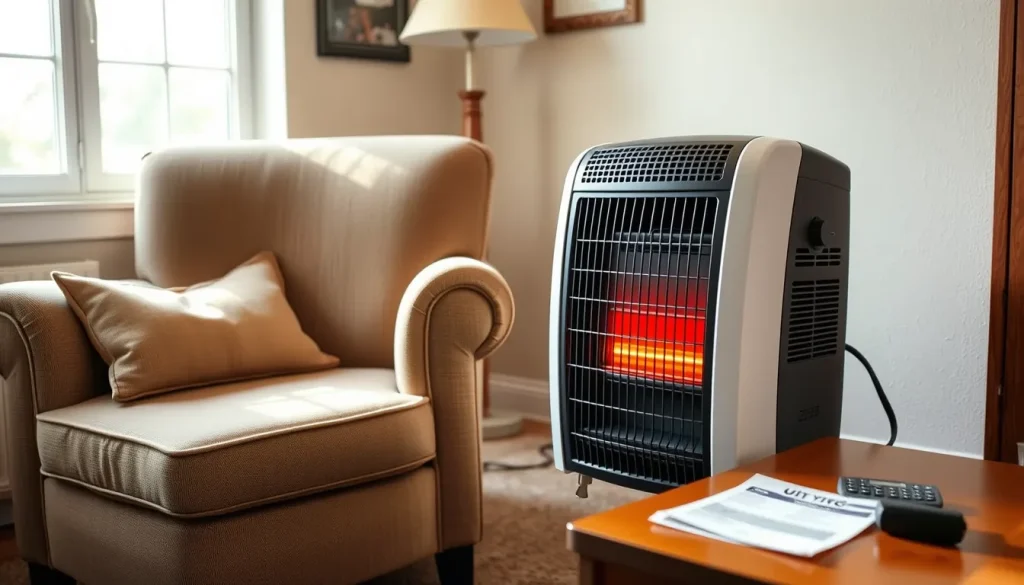
A space heater is one of the easier appliances to cost out because its power draw is printed on the label and its energy use is measured in kilowatt-hours. The catch is that the label shows the maximum, not what the heater uses every hour. A 1,500-watt heater on a thermostat may run at full power for a few minutes, cycle off, then restart; the average cost tracks the time it is actually heating.
Start with watts, hours, and your electricity price
The calculation is the same for any electric resistance heater:
cost = (watts ÷ 1,000) × hours × price per kWh
Watts measure power—how fast the heater uses electricity at a moment. Kilowatt-hours measure energy—the amount used over time. A 1,500-watt heater is 1.5 kilowatts. At full power for one hour, it uses 1.5 kWh. At 17¢ per kWh, that hour costs 1.5 × $0.17 = $0.255, or about 25.5¢ (WeekendCalc).
Most full-size space heaters draw up to about 1,500 watts on their highest heat setting (Consumer Reports; Appliance Energy Cost). Smaller models may use 750 watts or 1,000 watts. PickHVAC puts the common cost range at roughly 10¢ to 42¢ per hour for 750-watt to 3,000-watt heaters, depending on electricity price. That range is a guide, not a quote for a particular household.
Worked example: 1,500 watts for 8 hours a day
Suppose a household runs a 1,500-watt heater at full power for 8 hours a day, for 30 days, at an illustrative rate of 17¢ per kWh. These are assumptions, not a prediction of a specific bill.
- Convert watts to kilowatts: 1,500 ÷ 1,000 = 1.5 kW.
- Find daily energy use: 1.5 kW × 8 hours = 12 kWh per day.
- Find daily cost: 12 kWh × $0.17 = $2.04 per day.
- Find the 30-day cost: $2.04 × 30 = $61.20.
WeekendCalc rounds the same calculation to about $2 for an 8-hour day and about $61 for a month. Consumer Reports estimates about $2.10 per 8-hour day, or about $64 a month, based on the average cost of electricity it used. Small differences come from the electricity price and rounding.
If the heater runs only half the time because its thermostat cycles on and off, the average energy use is about half the full-power figure. In this example, 8 clock hours at a 50% duty cycle equals 4 full-power hours, or 6 kWh a day. At 17¢ per kWh, that is $1.02 a day and $30.60 for 30 days.
Cost by daily runtime
| Daily runtime | Monthly energy | Monthly cost |
|---|---|---|
| 2 hours | 90 kWh | $15.30 |
| 4 hours | 180 kWh | $30.60 |
| 6 hours | 270 kWh | $45.90 |
| 8 hours | 360 kWh | $61.20 |
These figures assume the heater is drawing its full 1,500 watts for every hour shown. A thermostat setting that lets the room cool between heating cycles will usually reduce the average, sometimes substantially. A cold room, poor insulation, or an open window can keep the heater near full power for longer.
How electricity price changes the answer
The same heater can cost twice as much in one place as another because residential electricity prices vary widely. Using the 8-hour, 30-day example—360 kWh—here is the effect of different rates:
| Price per kWh | Cost per full-power hour | Monthly cost |
|---|---|---|
| 12¢ | 18.0¢ | $43.20 |
| 17¢ | 25.5¢ | $61.20 |
| 25¢ | 37.5¢ | $90.00 |
| 32¢ | 48.0¢ | $115.20 |
One September 2026 state-rate compilation lists Texas at 15.6¢ per kWh and California at 31.8¢ per kWh. At those rates, the same 1,500-watt heater costs about 23.4¢ or 47.7¢ per full-power hour (Appliance Energy Cost). State averages still are not a quote for an individual household; local utility rates, tiers, and time-of-use periods matter.
Why the nameplate wattage is not the average
A heater labeled 1,500 watts can draw 1,500 watts when the heating element is on high, but it does not necessarily draw that much all the time. A built-in thermostat or external thermostat turns the element off when the room reaches the set temperature. The share of time the heater is actually drawing power is its duty cycle.
Duty cycle depends on room size, insulation, outdoor temperature, thermostat setting, air leaks, and how the heater is controlled. Many space heaters are claimed to heat only about 150 to 200 square feet, according to Consumer Reports, which notes that they are best used as supplemental heat rather than as a replacement for a whole-home system.
Heater type does not usually change the electricity cost at the same wattage. Ceramic, oil-filled, and infrared electric heaters all convert nearly all the electricity they use into room heat, so a 1,500-watt model costs about the same per hour as another 1,500-watt model running at full power (WeekendCalc). The differences are in warm-up speed, heat distribution, noise, and how comfortable the heat feels.
What the estimate leaves out
The formula estimates the variable cost of the electricity the heater uses. It does not represent a complete electric bill. Fixed customer charges, taxes, and other fees appear on a bill whether the heater runs or not. Tiered rates can make extra use cost more once a household crosses a threshold. Time-of-use plans charge different prices at different hours, and some plans include demand charges that a simple appliance calculation cannot capture.
There is also a difference between a bill’s effective average rate and the marginal price of one more kWh. The effective average rate is total bill divided by total kWh used; it includes fixed charges and taxes. The marginal price is what the next kWh costs under the household’s rate plan. For deciding whether to run a heater for another hour, the marginal price is usually the more relevant number.
The monthly figures here assume a 30-day month. A 31-day month, a billing period that is shorter or longer than 30 days, or a mid-month rate change will produce a different total. The estimate also excludes the purchase price of the heater, any extension cords or safety equipment, and maintenance.
Space heater versus heating the whole house
A space heater can be economical for one occupied room in some situations, especially if it lets the household keep the central thermostat lower. It is not automatically a money-saving substitute for a central heating system. Consumer Reports notes that electricity is generally pricier than natural gas, the most common whole-home heating fuel in the northern United States, and that space heaters should be used judiciously as supplemental heat.
The fair comparison is not simply the heater’s hourly cost against the furnace’s hourly cost. Compare the change in the whole bill: the space heater’s added electricity versus the central system’s avoided runtime, over the same weather and the same comfort level. A space heater used in one small room may compare well; several space heaters used throughout a house often do not.
How to estimate your own heater’s cost
- Find the heater’s wattage on its label or manual. If it has multiple settings, note the wattage for the setting you actually use.
- Find the price you pay per kWh on your electric bill. Use the supply or energy charge that applies during the hours you heat; if you are on a time-of-use plan, use the relevant period’s price.
- Estimate full-power-equivalent hours. If the heater runs 6 clock hours and cycles about half the time, count 3 full-power hours. A plug-in electricity monitor can replace this estimate with measured kWh.
- Apply the formula: watts ÷ 1,000 × hours × price per kWh. For a 1,000-watt heater used 5 full-power hours a day at 20¢ per kWh, the daily cost is 1 × 5 × $0.20 = $1.00, or $30 for 30 days.
- Check the result against your bill over a comparable period. If the heater is a major load, compare billing days and separate a usage change from a rate or fee change.
A practical next step is to open your latest electric bill and find the price per kWh that applies when the heater usually runs. Multiply that price by 1.5 for a 1,500-watt heater, or by 0.75 for a 750-watt heater, to get the full-power cost per hour. Then adjust downward for thermostat cycling and the hours you actually use it.
FAQ
Does a ceramic, oil-filled, or infrared heater cost less to run?
Not because of the heating element type. At the same wattage and runtime, electric resistance heaters use the same amount of electricity. Differences show up in warm-up speed, heat distribution, noise, and comfort. A lower-wattage model costs less per hour at full power but may heat more slowly or less.
How can I measure my heater's real electricity use?
Use a plug-in electricity monitor rated for the heater's load, or a compatible smart plug with energy monitoring. Run the heater normally for a representative period, read the kWh, and multiply by your rate. Do not use an underrated plug, power strip, or extension cord with a space heater.
Is it cheaper to run a space heater than central heat?
Sometimes for one occupied room, but not as a general rule. Consumer Reports notes that electricity is often pricier than natural gas and that space heaters are best for supplemental heat. Compare the heater's added electricity with the central system's avoided runtime over the same weather and comfort level.
What if my electricity plan has time-of-use rates?
Use the rate in effect during the hours you heat. The same heater can cost less per hour during an off-peak window than during an on-peak window. The formula does not change: watts ÷ 1,000 × hours × the applicable price per kWh.
Follow the evidence
Sources & references
- WeekendCalc. How Much Does It Cost to Run a Space Heater? Last reviewed October 11, 2026. https://weekendcalc.com/guides/how-much-does-it-cost-to-run-a-space-heater/
- PickHVAC. How Much Does It Cost to Run a Electric Space Heater? (With Calculator). June 3, 2025. https://www.pickhvac.com/space-heater/using/cost-to-run-electric-heater/
- Consumer Reports. Will Using a Space Heater Save You Money? Updated October 12, 2025. https://www.consumerreports.org/appliances/space-heaters/will-using-a-space-heater-save-you-money-a2378783171/
- Appliance Energy Cost. How much does a space heater cost to run? Updated September 2026. https://www.applianceenergycost.com/appliances/space-heater
Useful terms in this guide
- Watt (W)
- A measure of power—how fast a device uses electricity at a given moment.
- Kilowatt-hour (kWh)
- A measure of energy—1,000 watts used for one hour.
- Duty cycle
- The share of time a heater is actually drawing power, such as a 50% duty cycle when a thermostat cycles it on and off.
- Effective average rate
- Total electric bill divided by total kWh used; it includes fixed charges and taxes, so it can differ from the marginal price of one more kWh.
Have a question about these numbers?
Tell us what needs a closer look.